Freight brokers make money on the spread between what a shipper pays to move a load and what the broker pays a trucking company to haul it. A broker that charges a shipper $2,000 and pays the carrier $1,700 keeps $300. Out of that spread it pays its own staff, technology and claims, and it finances the gap between paying carriers in days and collecting from shippers in weeks. The spread widens when spot truck rates fall and narrows when they spike, so brokerage profits move against the freight market.
The largest broker shows how small the business is inside its headline numbers. In the third quarter of 2026 C.H. Robinson's North American Surface Transportation segment reported revenue of about $3.83 billion and adjusted gross profit of about $518 million (company 8-K, 28 October 2026). Roughly six of every seven dollars it billed belonged to the carriers.
What does a freight broker actually do?
US trucking is one of the most fragmented large markets in the economy: hundreds of thousands of carriers, most running fewer than ten trucks. A shipper with thousands of loads a year cannot manage that many relationships. A broker owns no trucks. It sits in the middle and does three things.
- Coverage. It finds a qualified truck for almost any load, at a price, within hours, from a network of tens of thousands of small carriers.
- Price discovery and risk transfer. It commits to a shipper's rate and absorbs the difference when the spot market moves.
- Service. It handles tracking, exceptions, claims and billing in one relationship.
On the shipper side, brokers win business three ways: annual or quarterly contract bids, where a shipper awards lanes in a routing guide; spot quotes for loads that fall out of the routing guide; and managed transportation, where the broker runs the shipper's whole transport function for a fee. On the carrier side, a carrier representative checks the trucking company's operating authority, insurance and safety record, negotiates a rate, issues a rate confirmation, tracks the load and pays after delivery against proof of delivery. The full mechanics are in the industry study of freight brokerage and digital freight platforms.
Gross revenue vs net revenue: why the numbers mislead
A broker reports the whole $2,000 as gross revenue. Its net revenue, also called gross margin or adjusted gross profit, is the $300 left after paying the carrier. Truckload brokers' gross margins run about 10–20% of gross revenue in normal years (company filings, reported). Comparing a broker's gross revenue with an asset carrier's revenue, without saying so, overstates the broker's size several times over.
The right lenses are net revenue, net revenue per load, and operating income as a share of net revenue. C.H. Robinson calls the last one its adjusted operating margin: 33.6% in the third quarter of 2026 (company).
| C.H. Robinson, Q3 2026 vs Q3 2025 | Figure | Change |
|---|---|---|
| Total revenue (gross) | About $5.36 billion | +29.5% |
| Adjusted gross profit (net revenue) | About $808 million | +14.5% |
| Income from operations | About $272 million | +23.1% |
| Average headcount | About 11,253 | −10.4% |
Source: company 8-K, 28 October 2026.
Gross revenue rose with freight rates. Net revenue rose with margin per load and volume. Net revenue per employee rose about 28%, because adjusted gross profit grew while headcount shrank. That last number is the one that compounds.
Why do broker margins move against the market?
Brokers sell to shippers at contract rates, often agreed in an annual bid, and buy from carriers at spot rates. The spread between those two prices is the business, and it swings with the cycle.
| Market phase | Spot vs contract | Effect on broker margin per load | Examples |
|---|---|---|---|
| Loosening | Spot falls below contract | Widens: broker buys cheap and sells at the agreed rate | 2019; 2022–23 |
| Trough | Spot well below contract; shippers rebid lower | Normalizes down; intense competition for volume | 2023–25 |
| Tightening | Spot rises toward and above contract | Compresses: committed loads covered at higher spot rates | 2017–18; mid-2020 to early 2021; 2026 |
| Peak | Spot far above contract | Recovers on spot loads as contracts reset higher | 2018; 2021 |
This is why brokers' net revenue is less cyclical than their gross revenue, but not stable. In 2026 the US truckload market tightened from the supply side, as enforcement of English-proficiency and licensing rules removed drivers and diesel prices jumped. C.H. Robinson repriced much of its contract book and lifted truckload adjusted gross profit per shipment about 17% year on year, while the Cass Freight Shipment Index fell 0.3% (company). How shippers, carriers and brokers write those contracts is the subject of Chapter 13 on contracts, pricing and the freight market.
How much profit does a freight broker make per load?
The book's Appendix A works a stylized example. It is an invented broker, not any company's figures. Each representative costs $85,000 a year and works 250 days; other operating costs are fixed per load; shippers pay in 45 days and carriers are paid in 7 days, with 40% taking two-day quick pay for a 2% fee.
| Stylized case | Revenue per load | Gross margin per load | Operating profit per load | Annual operating profit | Working capital |
|---|---|---|---|---|---|
| Balanced market | $2,200 | $330 | $189 | $22.7m | $29.5m |
| Tight market (like 2021) | $2,900 | $290 | $155 | $18.6m | $38.6m |
| Soft market (like 2023) | $1,900 | $323 | $180 | $19.4m | $23.0m |
| Growth bought with price | $2,200 | $110 | −$15 | −$2.7m | $43.7m |
| Automation: 30% more loads per rep | $2,200 | $330 | $202 | $24.3m | $29.5m |
Three things stand out. In a tight market the broker's revenue per load jumps but its margin falls, while its working capital swells because every invoice is bigger. A broker that buys growth by cutting its margin to 5% loses money on every load and ties up the most cash. And productivity is the durable lever: 30% more loads per representative raises profit at the same prices.
Why do freight brokers need so much cash?
A broker pays carriers within days, or the same day through quick pay, and collects from shippers in 30–60 days. It therefore carries receivables equal to several weeks of gross revenue. Rising rates and growth consume cash; a falling market releases it. Small brokers fund the gap with factoring or bank lines, and a large shipper's late payment or bankruptcy can strand them. Carriers, in turn, often sell their invoices to factoring companies to get paid in a day or two, a market covered in the industry study of trade finance, payments and working capital.
Asset-light vs asset-based brokers
| Model | Examples | Strength | Weakness |
|---|---|---|---|
| Non-asset broker | C.H. Robinson, TQL, RXO | Variable cost; covers any lane | No owned trucks in a tight market |
| Agent-based | Landstar | Agents and owner-operators carry most fixed cost | Dependence on agents |
| Carrier with brokerage arm | J.B. Hunt, Knight-Swift, Schneider | Owned capacity plus overflow | Arm competes with its own fleet |
| Digital broker | Uber Freight, Convoy (closed) | Automated matching and carrier apps | Venture-funded subsidies; margins below cost in the recession |
Consolidation is now under way at the top. RXO bought Coyote Logistics from UPS for about $1.025 billion, closing on 16 September 2024. On 5 October 2026 C.H. Robinson announced an agreement to buy RXO for about $5.3 billion in equity value, about $5.8 billion including debt, pending RXO's shareholder vote and antitrust clearance as of November 2026 (SEC filings, reported).
What are the biggest risks for freight brokers?
Fraud. Double brokering, stolen carrier identities and fictitious pickups surged in 2023–26. Verisk's CargoNet counted 3,594 cargo-theft events in the US and Canada in 2025, with confirmed thefts up 18% and estimated losses of about $725 million, up 60% (reported). FMCSA told Congress in 2025 that it lacked the data to quantify double brokering. For a small broker, one stolen load can wipe out a year's net revenue.
Liability. On 14 May 2026 the Supreme Court held 9–0 in Montgomery v. Caribe Transport II that state claims of negligent carrier selection against brokers are not pre-empted by federal law (reported). Carrier vetting is now a liability question as well as a fraud one.
Regulation. A broker needs FMCSA operating authority and a $75,000 bond or trust. FMCSA's financial-responsibility rule, in force from 16 January 2026, requires that security to be kept at the full amount at all times (reported).
Subsidized growth. The venture-funded digital brokers of 2015–22 grew by paying carriers more and charging shippers less. Most failed or retreated when the freight recession arrived. Our case study of why Convoy failed shows how that ended for the best-funded of them.
Freight brokers and the flow equation
The Flow Equation argues that a supply-chain business creates durable value only when four factors multiply: cost to serve, density, reliability and capital matched to the cycle. For a broker, cost to serve is the people, technology and claims cost per load; density is lane volume and carrier relationships that let it cover loads cheaply and reload trucks; reliability is coverage on hard lanes and protection against fraud; and capital is the working capital and balance sheet to survive a margin squeeze. The freight cycle is the weather, and fraud is the shock. Landstar, whose agents and owner-operators carry most of the fixed cost, is the industry's clearest case of capital matched to the cycle. For how brokers fit into the wider industry, read our guide to the logistics industry business model, and for the trucking side of the market, our comparison of LTL vs truckload.
The takeaway
A freight broker earns a spread, not a fare, and the spread moves against the market: it compresses when spot rates spike and widens when they fall. Gross revenue mostly belongs to the carriers, so the numbers that matter are net revenue per load, net revenue per employee and working capital. Growth bought with price consumes cash and earns nothing, while productivity per person is the lever that compounds. Chapter 13 of The Flow Equation explains how contracts and spot prices create that spread.
Frequently asked questions
What is a typical freight broker margin?+
Truckload brokers' gross margins are about 10–20% of gross revenue in normal years, according to company filings, and they move with the cycle. A broker charging $2,000 and paying the carrier $1,700 keeps a $300 spread, or 15%.
Why do freight brokers lose money when rates go up?+
Because many loads are sold to shippers at contract rates agreed months earlier, while carriers are paid at today's spot rate. When spot rises above contract, the broker pays more for the truck without being able to charge more for the load, and its margin compresses until contracts are repriced.
What does a freight broker need to operate legally in the US?+
Operating authority from the FMCSA and $75,000 of financial security, either a BMC-84 surety bond or a BMC-85 trust. Since 16 January 2026 FMCSA's financial-responsibility rule requires that security to be kept at the full amount at all times.
Who is the largest freight broker in the US?+
C.H. Robinson is the largest US freight broker, followed by the privately held TQL on most rankings. In October 2026 C.H. Robinson agreed to buy RXO for about $5.3 billion in equity value, a deal still pending as of November 2026.
Go deeper in The Flow Equation
Chapters
Industry studies
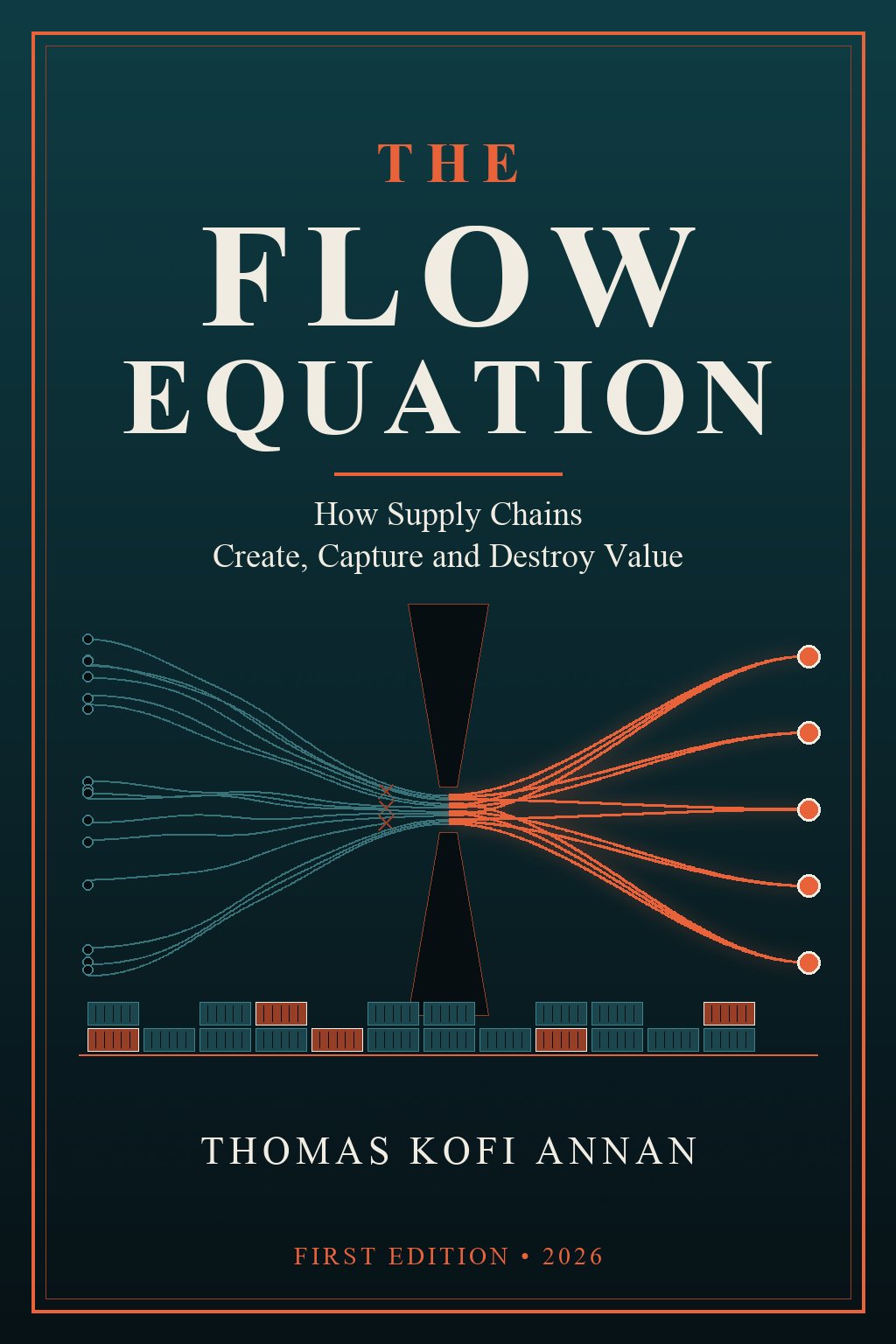
From the research behind The Flow Equation
How Supply Chains Create, Capture and Destroy Value
25 chapters, 24 industry studies, 100 companies and 848 strategic moves.
See the bookEducational content, not investment, legal, tax, medical or engineering advice. Figures marked “reported” come from filings and published sources that have not been independently audited.