The Equation Series
Menu
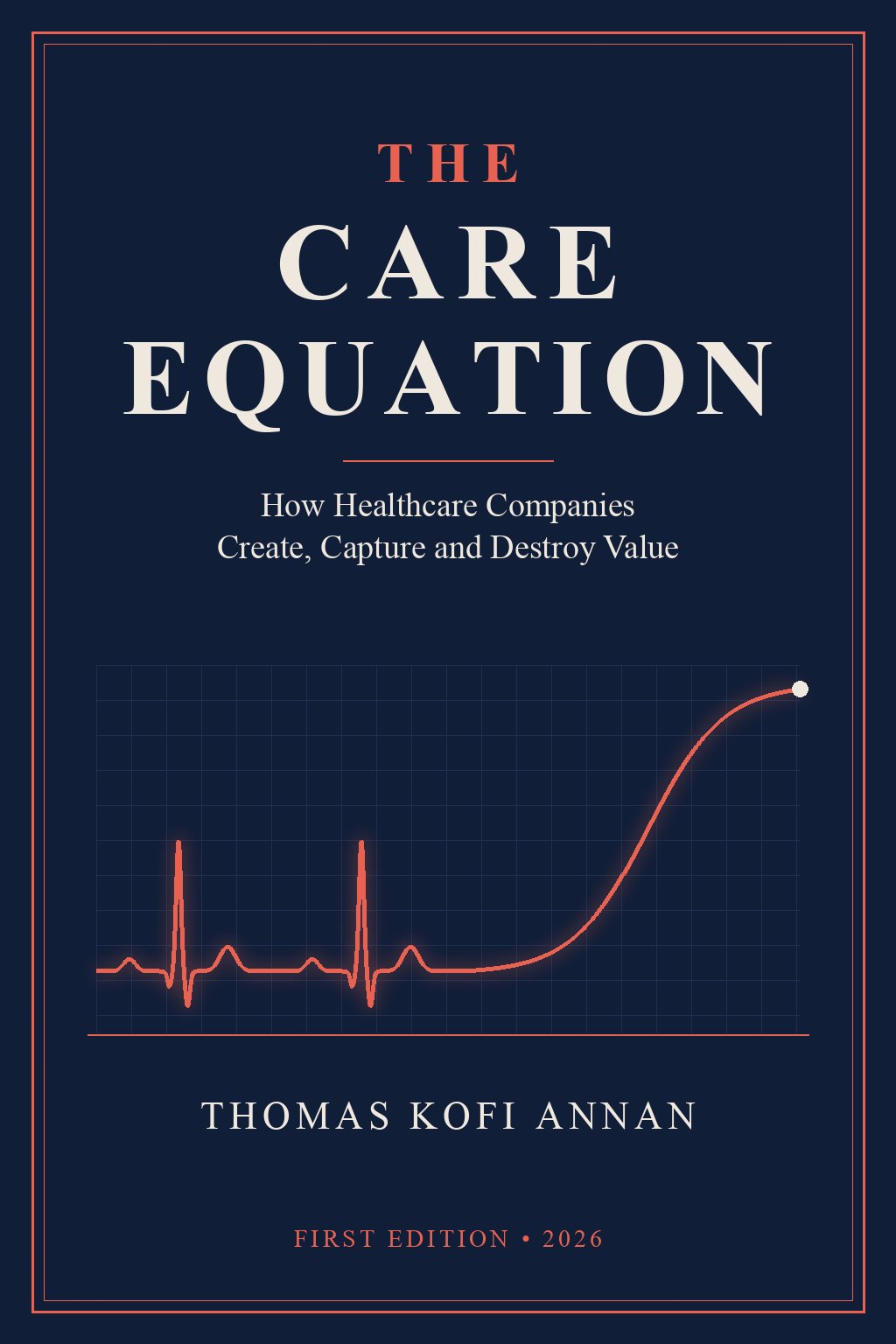
The Care Equation cover

Healthcare · Volume 1 of the Equation Series

The Care Equation

How Healthcare Companies Create, Capture and Destroy Value

By Thomas Kofi Annan · First edition, 2026

Healthcare is the largest industry in the world and one of the hardest in which to build a business. 3 trillion on health in 2024, nearly a fifth of its economy. Read more

25
chapters
24
industry studies
100
companies
881
moves

Complete EditionBest value

Everything above, at the best price

PDF + EPUB + M4B

$99

Buy Complete Edition

The Book

25 chapters · ~51,000 words

PDF + EPUB, plus the narrative edition

$29

Buy The Book

Research Companion

24 studies · 100 profiles · 881 moves · ~1.5 million words

PDF + EPUB, plus the narrative edition

$59

Buy Research Companion

Audiobook

158 hr 25 min across 4 volumes

M4B (chaptered)

$39

Buy Audiobook

From the preface

The care equation

Healthcare is the largest industry in the world and one of the hardest in which to build a business. The United States alone spent about $5.3 trillion on health in 2024, nearly a fifth of its economy. Some companies have turned that spending into lasting value: integrated systems that keep their members healthier, devices that changed how surgery and diabetes are managed, drugs that reshaped whole diseases, and, in places such as India and West Africa, models that bring care to people the system had left out. Many more have not. Well-funded start-ups have built products that clinicians would not use, programmes whose savings vanished under a randomised trial, insurers whose growth outran their underwriting, and roll-ups whose profits came from a gap in a payment formula until someone closed it. Some of the most admired companies in other industries tried to fix healthcare and left within three years.

The difference is rarely the technology alone. This book argues that a healthcare business creates durable value only when four things are true at once, and that the factors multiply rather than add: if any is zero, the result is zero. The care must improve health or lower its cost. There must be a payer willing and able to pay for it, from a budget that renews. The company must be able to reach that payer for less than the payer is worth. And the proof must be strong enough to survive contracting and regulation. Around those four factors sit two forces that no company controls, reimbursement policy and capital cycles, which behave like weather: they do not decide whether care works, but they decide how long a company has to show that it does. In healthcare the patient is rarely the buyer, the person who chooses is often the clinician, and the payer is usually an insurer, an employer or a government. Most of the failures in this book come from treating one of the four factors as given rather than earned.

The twenty-five chapters develop that view. Part I sets out why healthcare is not a normal market, how it became a business, how money flows from premiums and taxes to hospitals, doctors, insurers and drugmakers, and how value and evidence are judged. Part II follows the markets one by one: hospitals, physicians and outpatient care, insurers, government as payer, drugs and the pharmacy chain, devices and diagnostics, and care in the home and for the mind. Part III examines what it takes to build products that work, from the electronic record and digital health to artificial intelligence, business models, selling into healthcare and value-based care. Part IV covers investing, private equity and consolidation, regulation and privacy, prices and reform, and health systems around the world. Part V turns to people: the clinical workforce and how to build a healthcare company and its team. Part VI reads five cases for the decisions behind them. Each chapter opens with a case, explains the mechanics it illustrates, and closes by naming the factor of the equation on which its case turned.

The book · ~51,000 words

Contents

Each chapter has a free preview of its opening and section list.

Healthcare Research Companion · Part I

24 industry studies

The companion opens with an in-depth study of each part of the industry, backed by 26 technical exhibits: worked examples, diligence checklists and case studies.

01Hospitals and Health SystemsHospitals are the largest single line in US health spending (roughly a third of national health expenditure, ~$1.6 trillion a year; verify latest CMS figure), the largest private employers in many American cities, and the institutions every other part of healthcare has to sell to, contract with or compete against. They are also economically odd: most are nonprofit, they must treat anyone who arrives in the emergency department, they are paid different prices by different payers for the same service, and a typical one earns a thin operating margin that swings with labor costs, payer mix and policy. This section explains how hospitals and health systems make and lose money: ownership models (nonprofit, for-profit, public, academic), payer mix and the "cost shift," the drivers of margin, consolidation and its effect on prices, rural closures, the 340B drug discount program, and the policy and capital forces that will shape them through the late 2020s. A worked example computes a stylized hospital's margin under payer-mix, Medicaid and labor shocks.+ 2 exhibits02Physician Practices, Outpatient and Ambulatory CarePhysicians control most decisions in healthcare (admissions, referrals, procedures, prescriptions), but receive only about a fifth of US health spending as payment for their own services ("physician and clinical services," ~$1 trillion a year; verify latest CMS figure). Over twenty years the independent physician practice, once the default, has become the exception: by January 2026 about 82% of US physicians worked for hospitals, health systems or other corporate owners such as insurers and private-equity-backed groups (PAI/Avalere, reported). At the same time care has moved out of hospitals into ambulatory surgery centers, urgent care, retail clinics and virtual visits. This section explains how physicians are paid, why practices sell, what buyers want from them, the economics of ambulatory surgery and urgent care, why primary care is both under-funded and strategically prized, and what the retail and big-tech primary-care wave (VillageMD, Walmart Health, One Medical, Oak Street) taught investors.03Health Insurance and Managed CareIn the United States, health insurance is both a financial product and a care-management business. Insurers price risk, build provider networks, negotiate prices, process billions of claims and decide which care they will pay for, and the largest of them now also own doctors, pharmacies, PBMs and data businesses. Private health insurance pays for roughly a third of personal health care spending, and about half of Americans get coverage through an employer. Most of those covered workers (roughly six in ten or more) are in self-funded plans, where the "insurer" is really an administrator paid a fee and the employer carries the risk. This section explains the commercial market (fully insured vs ASO, the medical loss ratio, networks and utilization management), the Blue Cross Blue Shield system, the ACA exchanges, the underwriting cycle, the 2020s insurtech wave, and the 2024–26 period in which several large insurers withdrew earnings guidance as medical costs ran ahead of premiums. Government programs (Medicare Advantage, Medicaid managed care) are covered in 04.+ 2 exhibits04Medicare, Medicaid and Government PayersThe US government is the largest buyer of healthcare in the world. Medicare alone spent ~$1.1 trillion in 2024, about a fifth of national health spending, and Medicaid, the VA, TRICARE, the Indian Health Service and ACA premium subsidies add hundreds of billions more. More and more of that public money flows through private companies: in 2026 about 55% of eligible Medicare beneficiaries were in privately run Medicare Advantage plans (KFF), and most Medicaid enrollees are in state-contracted managed care plans. For those companies, government rules are the business model. Rate notices, risk-adjustment formulas, star ratings and state procurements decide revenue more than any sales team does. This section explains how traditional Medicare pays providers, how Medicare Advantage pays plans (benchmarks, bids, rebates, risk scores, stars), Part D after the Inflation Reduction Act, Medicaid financing and managed care, the 2025 federal Medicaid changes, and the VA and military systems. The commercial market is in 03.+ 2 exhibits05Pharmaceuticals and Drug CommercializationPrescription drugs are healthcare's most profitable product and its most politically exposed. A new medicine can take more than a decade and a reported ~$1–2.6B (capitalized, failures included; estimates vary widely) to reach the market. It then earns most of its lifetime revenue during a short window of patent and regulatory exclusivity, before generics or biosimilars cut its price by 80–90%. US net spending on medicines was ~$606B in 2025 (IQVIA), against ~$1.36T at list prices; the gap between the two is the rebate and discount system that the next section (Pharmacy, Distribution and PBMs) explains. This section covers how drugs are developed and protected, how they are priced and launched, the loss-of-exclusivity cliff, the GLP-1 obesity drugs that made Eli Lilly the first drugmaker valued at a reported ~$1T (November 2025), and the Inflation Reduction Act's Medicare price negotiation, the biggest change to US drug pricing in decades.06Pharmacy, Drug Distribution and PBMsBetween the drug company and the patient sits a supply chain that handles hundreds of billions of dollars a year and that few patients see: three wholesalers that distribute most US prescription drugs on margins of ~1%, about 60,000 pharmacies, and three pharmacy benefit managers (PBMs) that processed ~80% of US prescription claims in 2025 (Drug Channels). The physical chain moves boxes; the financial chain moves rebates, fees and "spreads" that nobody in the room fully discloses. That opacity made PBMs the most investigated intermediaries in American healthcare between 2022 and 2026: an FTC study and lawsuit, an Express Scripts settlement in February 2026, and federal PBM reform signed the same month. This section explains the physical and financial flows, how each player makes money, the vertical integration of insurers, PBMs and pharmacies, the transparency fights, and the alternative models (Cost Plus Drugs, transparent PBMs, manufacturer cash channels) trying to replace the old one.+ 2 exhibits07Medical Devices, Diagnostics and LabsMedical technology covers everything from tongue depressors to surgical robots, from glucose sensors to MRI scanners and the clinical laboratories that run billions of tests a year. The products differ, but the business questions are the same: how a product gets through the FDA (or a European notified body), who agrees to pay for it and under which code, who inside a hospital decides to buy it, and whether revenue comes once (capital) or keeps coming (consumables, service, tests). The best medtech franchises, such as Intuitive Surgical's da Vinci and the continuous glucose monitors from Dexcom and Abbott, lock in recurring revenue tied to procedures or patients. The worst failures, from Theranos to the Philips Respironics recall, show what happens when the evidence or the quality system does not hold. This section covers device business models, regulatory pathways, coverage and payment, the hospital buyer, diagnostics and labs, and imaging.08Post-Acute, Home Health and Senior CareWhen a patient leaves a hospital, or when an older person can no longer manage alone, care moves to a set of providers that most healthcare business discussions ignore: skilled nursing facilities, home health agencies, hospices, rehabilitation hospitals, assisted living communities and programs like PACE. Together they absorb tens of billions of Medicare dollars a year and most of Medicaid's long-term care spending, and they sit at the center of two forces: the ageing of the baby boomers (the first of whom turn 80 in 2026) and the push by Medicare Advantage plans and value-based care groups to move patients out of expensive institutional settings. This section explains the settings, how each is paid, why margins differ so much between Medicare and Medicaid patients, the real-estate structures behind nursing homes and senior living, the move of hospital-level care into the home, and the consolidation of home health and hospice by insurers such as UnitedHealth and Humana.09Behavioral and Mental HealthBehavioral health covers mental illness, substance use disorders and the psychological side of physical illness. It is one of the largest sources of disability in every country, and it is one of the worst-served parts of healthcare. Demand is high, supply is short, payment is low, and many clinicians do not take insurance. Treatment depends on a relationship that lasts weeks or months, rather than on a procedure. Those facts made behavioral health the biggest single theme of the 2020–22 digital health boom, and its clearest bust: therapy marketplaces, employer mental-health benefits and tele-psychiatry start-ups raised billions, and several then ran into regulators, falling consumer demand or their own unit economics. This section explains the care continuum and who pays for it, why therapists drop out of insurance networks, what parity law does and does not do, how substance-use treatment is organized and financed, the business models of digital mental health, the 2020–23 boom and bust, and how an expert reads the space.10Health IT, EHRs and InteroperabilityThe electronic health record (EHR) is the operating system of a modern hospital. It holds the chart, places the orders, runs the pharmacy and the lab, drives the bill and controls what every clinician sees. The US went from roughly one hospital in ten having even a basic EHR in 2008 to near-universal adoption within a decade, paid for in large part by the HITECH Act's incentive payments. That subsidy created a winner-take-most market dominated by Epic, with Oracle Health (Cerner) a distant second, and it left a second problem behind: records that do not move easily between systems. This section explains how EHRs are built, bought and paid for, the standards that carry data between them (HL7 v2, C-CDA, FHIR, X12, DICOM), the policy stack built to force data to flow (Meaningful Use, the 21st Century Cures Act, information-blocking rules, TEFCA, CMS API mandates), and the landmark cases from Kaiser Permanente's Epic bet to the VA's troubled Oracle rollout. The supporting files compute a stylized EHR replacement business case and tell the Epic vs Cerner story in detail.+ 2 exhibits11Digital Health, Telehealth and Virtual CareTelehealth existed for decades as a niche: rural specialist consults, tele-stroke, nurse lines, and a handful of employer-paid "doctor on demand" services. In March 2020 the pandemic and emergency waivers turned it, within weeks, into a large share of US outpatient visits, and investors priced the change as permanent. It was partly permanent. Video and audio visits settled at a mid-single-digit share of all claims, concentrated in mental health. Meanwhile direct-to-consumer (DTC) telehealth brands built large cash-pay businesses around prescriptions, and remote monitoring grew into a billing category big enough to attract federal scrutiny. This section covers the modalities, who pays for each, the regulatory rules that decide what can be built, DTC and virtual-first models, the 2020–21 peak and the reset, the evidence, and the landmark companies. The supporting files compute the economics of a remote patient monitoring (RPM) program and tell the story of Teladoc's $18.5 billion Livongo deal.+ 2 exhibits12AI in HealthcareMedicine has been "about to be transformed by AI" since expert systems such as MYCIN in the 1970s. The record since then is mixed: narrow, well-validated tools (diabetic-retinopathy screening, stroke triage, ECG interpretation) have earned regulatory clearance and some payment, while the most publicised bet, IBM Watson Health, was sold in parts in 2022. Large language models changed the picture after late 2022. The first category to spread quickly was not diagnosis but paperwork: ambient AI scribes that draft clinical notes from a recorded visit. This section covers the main product categories, how FDA regulates software as a medical device, how AI gets paid for, the evidence so far, the bias and safety record, the payer side (prior authorization and claims algorithms), and the company landscape. The supporting files work through ambient-scribe ROI and imaging-AI base rates in Python and give a diligence checklist.+ 2 exhibits13Clinical Quality, Patient Safety and OutcomesEvery healthcare company claims to improve quality. Few can show it. Quality is hard to measure, slow to change, confounded by who the patients are, and paid for only indirectly. Yet quality measures now move real money: Medicare Advantage star ratings shift billions of dollars of bonus payments, hospital penalty programmes adjust Medicare payments by up to several percent, and outcome claims decide whether employers, payers and health systems buy digital-health and value-based-care products. This section explains how quality is defined and measured (HEDIS, CAHPS, star ratings, safety indicators), the patient-safety movement since *To Err Is Human*, how evidence is ranked (RCTs, observational studies, real-world evidence), and, most practically, how to judge an outcomes claim.14Revenue Cycle, Billing, Coding and ReimbursementIn most industries a company sends an invoice and gets paid. In US healthcare a provider records care in clinical language, translates it into thousands of standard codes, prices it against a list price nobody pays, submits it electronically through a clearinghouse to a payer with its own rules, and then waits, appeals, rebills and chases the patient for the rest. That chain is the revenue cycle, and it costs the US system hundreds of billions of dollars a year in administration. This section explains the code sets (CPT, HCPCS, ICD-10, DRGs, APCs), how claims move, why denials and prior authorization have become a battleground between providers and payers, how hospitals and practices measure and outsource the work, and what the February 2024 Change Healthcare cyberattack showed about how concentrated this plumbing has become. A worked example traces one stylized hospital's charges to cash; a case study covers the Change Healthcare attack.+ 2 exhibits15Value-Based Care and Risk Contracting"Value-based care" (VBC) is any arrangement in which a provider's pay depends partly or wholly on the total cost and quality of care for a group of patients, not only on the number of services billed. It ranges from small quality bonuses on top of fee-for-service to full capitation, where a provider group takes a fixed monthly payment per member and is responsible for nearly all of that member's medical spending. The idea has had bipartisan support for 15 years, and CMS has said it wants every traditional Medicare beneficiary in an accountable-care relationship by 2030. The business record is mixed. Integrated systems (Kaiser), disciplined senior-focused clinics (Oak Street Health, ChenMed) and ACO enablers (Aledade, Privia Health) built real businesses. A wave of 2020–21 public listings (agilon health, Cano Health, Bright Health, CareMax, Babylon Health) lost most or all of their value when Medicare Advantage revenue was cut and medical costs rose at the same time. This section explains the contract types, the math of shared savings and capitation, why risk-bearing companies are really small insurers, and why so many failed. The supporting files compute a full-risk clinic's J-curve and MSSP payouts, and dissect the failures.+ 2 exhibits16Business Models and Unit EconomicsThe US spends about $5 trillion a year on healthcare, roughly 18% of GDP (CMS National Health Expenditure accounts; verify latest year). Almost none of that money passes directly from the person who receives care to the person who gives it. An insurer, an employer, a government program or a pharmacy benefit manager usually sits in between, and each one has its own revenue unit, its own budget cycle and its own idea of value. A healthcare business model is first an answer to three questions: who pays, per what unit, and out of whose budget? This section maps the revenue units used across healthcare (fee-for-service, case rates, capitation, percent of premium, PEPM, per-enrolled-member fees, subscriptions, software licences, transaction fees, rebates), the unit economics that follow (per-member math, provider margins, two-layer CAC and payback in B2B2C, gross margin by model, capital intensity and working capital), public benchmarks, cases and pitfalls. A worked example computes the economics of a digital chronic-care program sold to employers, and a checklist sets out diligence questions by business type.+ 2 exhibits17Go-to-Market: Selling to Health Systems, Payers and EmployersHealthcare is the largest business market most founders will ever sell into. It is also one of the slowest. The person who benefits from a product (a patient), the person who uses it (a clinician), the person who approves it (a committee) and the person who pays for it (a hospital finance office, a health plan or an employer) are almost never the same. Each has a different definition of value and a different budget calendar. This section covers who buys inside hospitals and health systems, health plans, employers and life-sciences companies; how group purchasing organizations (GPOs), EHR marketplaces, brokers, consultants and PBMs act as channels; how a pilot becomes a contract; the numbers to plan with; and the landmark cases that show what works.18Healthcare Investing and Venture CyclesHealthcare is the largest spending category in the US economy and one of the most heavily venture-funded. It has also produced one of the sharpest boom-and-bust cycles in modern venture. US digital health venture funding went from ~$7.4bn in 2019 to ~$29.1bn in 2021, then fell to ~$10.1bn in 2024, about 65% below the peak (Rock Health, reported). In between came a wave of SPAC mergers and IPOs (Clover, Babylon, Cano, Talkspace, Hims & Hers, Butterfly, Oscar, Bright, agilon) whose outcomes ranged from bankruptcy to a tenfold gain. From 2024 a new cycle formed around generative AI. This section covers who funds healthcare companies, how much they invested and when, why the 2020–21 boom happened and why it ended, the SPAC and IPO class and its fate, the AI rebound, and how experienced investors underwrite a healthcare company. Exits, private equity and consolidation are covered in section 19.19Private Equity, M&A and ConsolidationUS healthcare has been consolidating for forty years, and the pace has not slowed. Hospitals merged into regional systems, then into multi-state systems. Hospitals and insurers bought physician practices, until roughly four in five US physicians worked for a hospital, health system or corporate owner. Private equity firms rolled up anesthesia, dermatology, emergency medicine, gastroenterology and many other specialties, and bought hospitals, nursing homes and hospices. The largest insurers became vertically integrated conglomerates: UnitedHealth Group owns an insurer, a PBM, a data and claims-processing business, and the largest physician network in the country. Some of these deals created real value. Others produced higher prices, worse care and spectacular failures: Steward Health Care, Envision Healthcare and Prospect Medical. This section covers why healthcare consolidates, how hospital mergers, physician roll-ups, PE hospital and real-estate deals and vertical integration work, what the evidence says about their effects, the antitrust and state-law toolkit, and how an experienced deal person reads a healthcare transaction.+ 3 exhibits20Regulation, Compliance and PrivacyHealthcare is the most heavily regulated large industry in the US economy. A product that would be a simple app in another sector can be a medical device, a covered entity's business associate, a federal health care program referral source and the unlicensed practice of medicine, all at once. This section maps the rules that decide what a healthcare company may sell, how it may be paid, whom it may pay, what it may do with data and who may deliver care: the FDA, HIPAA and the FTC, the fraud-and-abuse trio (Stark, the Anti-Kickback Statute and the False Claims Act), the corporate practice of medicine, licensure and controlled-substance prescribing, and the state laws layered on top. It ends with the international rules (GDPR, EU MDR and AI Act, India, and African data-protection law) that matter for the global and West African thread of this knowledge base.21Health Policy, Reform and Pricing TransparencyIn US healthcare, Congress and CMS are the largest market makers. Medicare and Medicaid (1965) created the modern hospital and physician business. The HMO Act (1973) seeded managed care. Prospective payment (1983) changed how hospitals behave. Medicare Part D and Medicare Advantage (1997–2003) created two of the largest profit pools in the industry. The Affordable Care Act (2010) created the exchanges, expanded Medicaid and rewrote insurance rules. The No Surprises Act (2020), the price-transparency rules (2019–20) and the Inflation Reduction Act (2022) went after prices directly. The 2025 reconciliation law and the expiry of enhanced ACA subsidies at the end of 2025 started to reverse some coverage gains (CBO projects ~10m more uninsured by 2034 from the law alone). This section explains the main reforms, how they changed who gets paid what, and how operators and investors should read policy.22History of the Business of HealthcareAmerican healthcare was not designed. It grew in layers, and each layer was a response to the money problem the previous layer left behind. Charity hospitals needed paying patients, so prepaid hospital plans appeared. Wartime wage controls and a tax ruling tied those plans to employers. The elderly and the poor were left out, so Congress created Medicare and Medicaid in 1965 and paid hospitals whatever they said care cost. Cost-based payment made hospitals attractive to investors, so investor-owned chains such as HCA and Humana were born. Runaway costs then produced HMOs, prospective payment and managed care. The backlash against managed care produced consolidation, vertical integration and, from 2009, a federally funded digital layer. This section traces that sequence from the voluntary hospital to the 2024 Change Healthcare hack. It covers the business models each era produced and the patterns that keep coming back. If you know the history, it is easier to tell a structural change from a rebranding.23Workforce, Clinicians and Building a Healthcare CompanyHealthcare is a labour business. Wages and benefits are the largest cost line for almost every provider, usually around half or more of a hospital's operating expenses, and the supply of clinicians is set by licensing boards, residency caps and training pipelines that take a decade to change. This section covers both sides of that fact. The first half is the workforce: physician and nurse supply, burnout, the travel-nurse and staffing-agency boom of 2020–22, scope-of-practice fights, unions and the global migration of health workers. The second half is what it means for founders: why every healthcare company needs clinical leadership with real authority, which roles do not exist in a normal software company, how to hire and pay clinicians, and how boards and governance fail. The two halves are linked. Most healthcare start-ups either sell to the workforce, try to make it more productive, or employ it.24Global Health Systems and Emerging MarketsEvery country has to answer the same three questions: how to raise money for healthcare, how to pool the risk, and how to pay the people and institutions that provide care. The answers differ enormously. The US spends ~17% of GDP on health, more than any other country and over 40% of all health spending in the world, through a mix of employer insurance, government programmes and out-of-pocket payments. The UK runs a tax-funded National Health Service. Germany and Japan run compulsory social insurance. India and Nigeria still finance a large share of care out of patients' pockets. Ghana built a national health insurance scheme funded largely by a sales levy, Rwanda reached near-universal coverage through community-based insurance, and China extended basic insurance to ~95% of its population in about a decade. For a healthcare company, the system determines who the buyer is, how prices are set and how fast anything new can spread. This section covers the main system models, how financing and provider payment work, profiles of the systems that matter most for business (the UK, Europe, Japan, Singapore, China, India, South Africa, Ghana, Nigeria, Kenya and Rwanda), mobile health and logistics innovation in Africa, cross-border companies, and how an expert thinks about entering a new health market.+ 3 exhibits

Healthcare Research Companion · Part II

100 companies, 881 strategic moves

A profile of each company, followed by its defining moves year by year from 1833 to 2026: what was decided, why, how it was financed, and what happened next.

Browse all 100 →

Audiobook & narrative editions

158 hr 25 min of narration

Both volumes are rewritten as narrative editions that read straight through, in long-form prose instead of tables. The audiobook is narrated from those editions as chaptered M4B files that play in Apple Books, VLC, BookPlayer and most audiobook apps.

  • The Book16 hr 16 min
  • Companion Volume 1 - Industry Studies20 hr 6 min
  • Companion Volume 2 - Companies A to I61 hr 19 min
  • Companion Volume 3 - Companies I to Z and Timeline60 hr 44 min

Appendix C

Glossary: 43 terms

Read the full glossary →
340B
A federal programme requiring drug manufacturers to sell outpatient drugs at steep discounts to eligible hospitals and clinics, which may bill insurers at higher rates.
ACO
Accountable care organisation: a group of providers that shares in savings, and sometimes losses, against a spending benchmark for a population.
Anti-Kickback Statute
The federal criminal law that prohibits paying or receiving anything of value to induce referrals of business paid by federal health programmes.
ASO
Administrative services only: an arrangement in which a self-insured employer pays claims and an insurer is paid a fee for network and administration.
AWP
Average wholesale price: a list-based benchmark used to set pharmacy reimbursement.
CAC
Customer acquisition cost: the cost of winning and launching a customer.
Capitation
A fixed payment per person per period to cover a defined set of services, transferring cost risk to the recipient.
Coding intensity
The tendency of risk scores in Medicare Advantage to rise faster than underlying morbidity because of more complete or more aggressive diagnosis coding.

From the blog

Read before you buy

All 8 articles →

The Care Equation

Learn the framework from the book. Test it against the companion.

Choose an edition

More in the series