The Equation Series
Menu
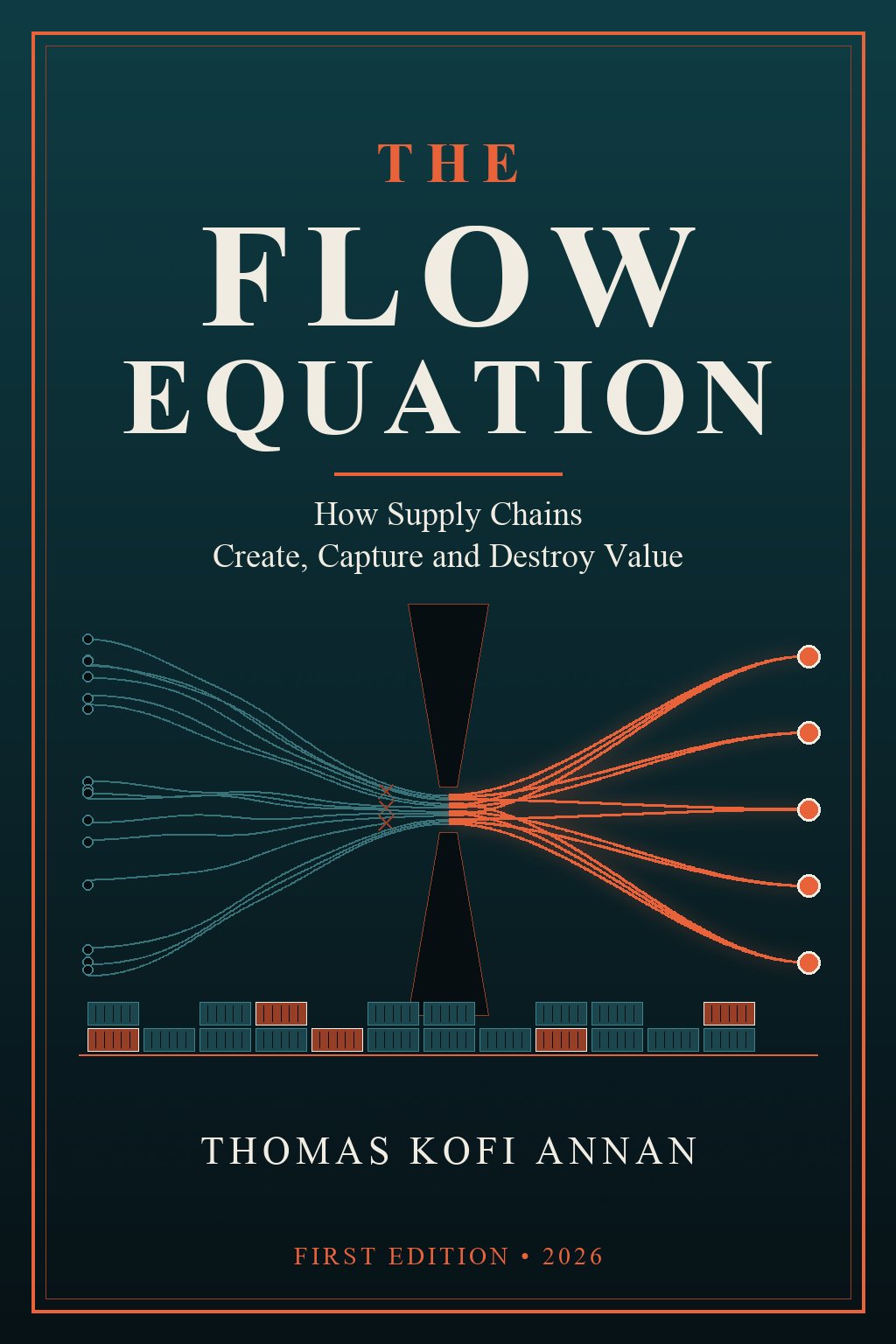
THEProductionEquationHow Manufacturers Create, Capture and Destroy ValueComing soon

Manufacturing · Volume 10 of the Equation Series

The Production Equation

How Manufacturers Create, Capture and Destroy Value

By Thomas Kofi Annan · First edition, 2026

In October 2025 the Federal Aviation Administration told Boeing that it could build 42 737s a month. For the previous twenty-one months the regulator had held the company to 38, ever since a door plug blew out of a ten-week-old 737 MAX 9 on 5 January 2024 because four bolts had not been put back at the factory. Read more

25
chapters
24
industry studies
100
companies
844
moves

Coming soon

The Production Equation is written and in production. Leave your email and we will tell you the day it is released.

Notify me

From the preface

The production equation

In October 2025 the Federal Aviation Administration told Boeing that it could build 42 737s a month. For the previous twenty-one months the regulator had held the company to 38, ever since a door plug blew out of a ten-week-old 737 MAX 9 on 5 January 2024 because four bolts had not been put back at the factory. Demand, a backlog of thousands and $24.25 billion of new equity could not raise its output until it had shown the FAA, with data, that it could build the aircraft right. Two months earlier, on 22 August 2025, the US government had become the largest shareholder in another manufacturer, taking about 9.9% of Intel, 433.3 million shares for about $8.9 billion, paid for largely by converting grants already promised under the CHIPS Act. Intel had broken ground for a fab complex in Ohio in 2022; by 2025 it expected the first module to operate in 2030–31, and in October 2026 a roof truss was going up on a site where about $5 billion had already been spent (reported). One manufacturer had customers, capacity and capital and was held back by its process. The other had public money, a site and a plan, and was still looking for the volume that would fill the plant.

The difference is rarely the quality of the machines. This book argues that a manufacturer creates durable value only when four things are true at once, and that the factors multiply rather than add: if any is zero, the result is zero. It must have a product worth making, one customers will buy in enough volume and at a price above its full cost, across the cycle and not just at its peak. It must have process capability, the ability to make that product right, safely and repeatably, which is the hardest factor to buy and the easiest to lose. It must have utilisation and scale, enough volume through its fixed assets that each extra unit costs less than the last. And it must have capital matched to the cycle, balance sheets, pensions, tooling, working capital and public money financed to survive the downturn and the long ramp from groundbreaking to volume. Around those four factors sit two forces no manufacturer controls, the demand and input cycle and policy and geopolitics, from tariffs and subsidies to wars, pandemics and floods. They behave like weather: they do not decide whether a manufacturer is sound, but they decide how long an unsound one survives, and they can ruin a sound one built for fair weather only. Most of the failures in this book come from treating one factor as proven because another was: a subsidy mistaken for a product worth making, a pre-order list mistaken for demand, automation mistaken for process capability, a boom-year price mistaken for unit cost, a tariff mistaken for a competitive cost.

The twenty-five chapters develop that view in seven parts. Part I explains why making things is hard to make pay, how manufacturing became a business, where a manufacturer's margin goes, and why production figures need definitions before they can be trusted. Part II takes the industries one at a time: cars and the electric-vehicle transition, aircraft and engines, machinery and the installed base, chips, chemicals and their liabilities, steel and metals, and consumer goods, devices and contract manufacturing. Part III examines what it takes to build things that work: a product worth making, process capability and the Toyota system, automation, the make-or-buy decision, plants and their ramps, and quality and safety as the licence to operate. Part IV covers capital cycles and break-ups, industrial policy and public money, tariffs and reshoring, energy and heavy industry, and manufacturing around the world. Part V turns to people: leadership, labour and culture, and how to build a manufacturing company. Part VI reads five cases for the decisions behind them, and the Practical Reference supplies worked examples, checklists, a glossary and a guide to the evidence. Each chapter opens with a documented case, explains the mechanics it illustrates, works one stylized example and closes by naming the factor of the equation on which its case turned.

The book · ~100,000 words

Contents

Each chapter has a free preview of its opening and section list.

Manufacturing Research Companion: Companies, Strategic Moves, and Technical Studies · Part I

24 industry studies

The companion opens with an in-depth study of each part of the industry, backed by 14 technical exhibits: worked examples, diligence checklists and case studies.

01Manufacturing Economics, Cost Curves and Operating LeverageA manufacturer sells a physical unit and pays for it three times: once for the materials in it, once for the conversion that turns those materials into a product (labour, energy, machine time, scrap and rework), and once, in advance and whether or not the unit is ever sold, for the plant, tooling, engineering and people that make conversion possible. The third payment is what makes manufacturing different from trading. Fixed cost turns volume into margin on the way up and into losses on the way down, so a manufacturer's profit moves much more than its revenue. That is operating leverage. Cost also falls as a product is made more often, because workers, engineers and suppliers learn. That is the learning curve, first written down for aircraft by T. P. Wright in 1936 (from memory, verify) and visible in the Model T, solar modules and lithium-ion batteries. The United States still makes a lot: manufacturing value added was ~$2.95 trillion at an annual rate in Q3 2025, roughly 9.5% of GDP in current dollars (BEA via FRED; the share from a secondary summary, verify). But it employs fewer people each cycle. Revised Bureau of Labor Statistics data show ~103,000 manufacturing jobs lost between January 2025 and January 2026 (reported), and the Federal Reserve's G.17 release put total-industry capacity utilisation in the mid-75% range through mid-2026 (release of 18 Aug 2026), below its long-run average (from memory, ~79–80%, verify). Two current cases show both mechanisms. Boeing carried ~$13.9bn of 787 deferred production costs at the end of 2025: the excess of early units' cost over their average cost, booked as an asset to be recovered from later, cheaper units (10-K and Boeing's investor table). Ford took ~$19.5bn of charges in December 2025 when the electric-vehicle volume its plants were sized for did not arrive (Shared facts). This section explains how a manufacturer's cost stack is built, why fixed cost and scale dominate it, how learning curves work and fail, how mix and pricing power decide margins, and how to read the US manufacturing base in numbers. The companion worked example computes a learning curve and the cost of the first 1,000 units of a new product.+ 1 exhibit02Production Systems: Lean, TPS, Six Sigma and Business SystemsA production system is the set of rules a factory uses to decide what to make, in what order, at what pace, with how much inventory, and what to do when something goes wrong. It is the least visible and most valuable asset a manufacturer has: it cannot be bought with the machines, and it is the part of process capability that competitors find hardest to copy. Ford's moving assembly line at Highland Park (1913, from memory, verify) made the car cheap by making one product the same way at enormous volume. General Motors under Alfred Sloan added variety and management by numbers. Toyota, too small and short of capital after the war to copy Ford, built a system under Taiichi Ohno from the late 1940s through the 1970s that made small batches of many models with little inventory and stopped the line at every defect: just-in-time, kanban, jidoka, levelled production and continuous improvement. The clearest proof that the system, not the workforce or the machines, made the difference came from Fremont, California. GM had closed its plant there in 1982; NUMMI, the GM–Toyota joint venture agreed in February 1983, reopened it with largely the same UAW workforce and began production in December 1984, and within a few years reached quality and productivity far above the old plant's (MIT research, reported; equal to Supply chain: Toyota). Others turned the methods into management systems: Motorola's and GE's Six Sigma, the Danaher Business System, Illinois Tool Works' 80/20 — whose "enterprise initiatives" the company credited with 130 basis points of its 26.3% operating margin in 2025 (company) — and GE Aerospace's "FLIGHT DECK". The lesson runs the other way too. Boeing's 2024 door-plug accident and the FAA's production cap showed what happens when a production system gives way to schedule pressure (03). This section explains the main production systems, what they are for, how they spread and failed to spread, what lean is not, and how to judge a company's claims about its "operating system". The companion worked example computes takt time, line balancing and work-in-process (Little's law) for one stylized assembly cell.+ 1 exhibit03Quality, Safety, Recalls and Product LiabilityQuality is the factor of the production equation that can go to zero overnight. A plant can have a product customers want, full lines and a sound balance sheet, and still destroy its value with one escape: a door plug reinstalled without its four bolts on a ten-week-old Boeing 737 MAX 9 (Alaska Airlines Flight 1282, 5 Jan 2024), after which the FAA capped 737 output at 38 a month and allowed 42 only in Oct 2025; an airbag propellant that degraded with heat, humidity and age, which turned Takata into the largest auto recall in US history (~67m inflators in ~42m US vehicles) and a guilty plea; an ignition switch that General Motors knew was weak for years before its 2014 recall. Quality failures are also routine: US carmakers file hundreds of safety recalls a year with NHTSA, and in 2025 Ford alone filed a record ~152–153 campaigns covering ~12.9m vehicles — more vehicles than the next nine manufacturers combined (NHTSA data via press tallies, Dec 2025–Jan 2026; the previous single-company record was GM's 77 campaigns in 2014, reported). In Europe, Stellantis booked a €4.1bn warranty-provision change in its Feb 2026 reset, which management attributed to quality problems, and Volkswagen's 2015 diesel defeat device showed that measurement itself can be the defect. This section explains how quality is measured and costed, the systems and standards that make it repeatable (APQP, PPAP, FMEA, ISO 9001, IATF 16949, AS9100, ISO 13485), the US recall regimes (NHTSA, CPSC, FAA, FDA) and their European counterparts, the landmark failures, product liability and mass torts, and how to read a company's quality claims. Two companion files give a worked example of what a quality escape costs and when a recall beats waiting, and a supplier-quality audit checklist.+ 2 exhibits04Automation, Robots, Controls and the Smart FactoryAutomation is the factor most often mistaken for another. Bought well, it raises process capability (a robot welds the same seam the same way every cycle), raises utilisation (a cell runs a third shift without overtime) and lowers unit cost; bought badly, it is a large fixed cost that makes a line less flexible, less reliable and harder to fix than the people it replaced. The world installed 542,076 industrial robots in 2024, more than half of them in China (~295,000), against 34,200 in the United States (−9% on 2023) and 30,600 in Korea (IFR *World Robotics 2025*, Sep 2025, reported). Measured by robots per 10,000 manufacturing employees, Korea leads at ~1,220 and the US is around 307, outside the top five (IFR, reported). The control layer that runs those robots and every other machine — programmable logic controllers, drives, sensors and safety systems — is a quieter, more profitable business dominated by Rockwell Automation in North America and Siemens in Europe. Two episodes bracket the US story: General Motors' 1980s automation spending, which did not close its gap with Toyota, and Tesla's 2018 Model 3 ramp, after which Elon Musk said "excessive automation at Tesla was a mistake" (Apr 2018) and the company reached 5,000 cars a week only in the last week of June 2018, partly on a line built in a tent (Energy: Tesla). In Europe the robot business itself is changing hands: ABB agreed on 8 Oct 2025 to sell its robotics division to SoftBank Group for an enterprise value of $5.375bn, with closing expected in mid-to-late 2026 (company; completion not confirmed at early Nov 2026 — verify). This section covers the automation stack from sensor to MES, controls and motion, industrial robots and cobots, machine vision, robot density by country, the economics of automating, over-automation and lights-out claims, AI and the "smart factory", and how to read automation claims. Humanoid robots and robot makers as businesses belong to a later Robotics vertical and are mentioned only in passing. There is no worked example: the main book's Appendix A reshoring example already computes the unit cost of an automated US cell against manual US, Mexican and Chinese production.05Industrial Software: PLM, CAD, MES and the Industrial IoTEvery physical product now starts as a file and every modern factory runs on software, and the companies that own those files and systems have become some of the most valuable in manufacturing. The design and simulation layer consolidated sharply in 2025: Siemens completed its purchase of the US simulation company Altair in Mar 2025 for an enterprise value of ~$10bn, and Synopsys, the chip-design software company, completed its ~$35bn acquisition of Ansys on 17 Jul 2025 (company releases, reported) — both betting that designing a product, its chips and its behaviour will merge into one simulated model. The industrial-internet layer went the other way: GE's Predix platform, launched in 2015 to make GE a leading software company, never became one (General Electric), and PTC, which had bet on the industrial IoT with ThingWorx (2013) and Kepware (2015), sold both to TPG, closing on 16 Mar 2026 with $523m of cash at closing (company release; TPG combined them with GE Vernova's former Proficy software as Velotic, reported); on 5 Oct 2026 PTC itself agreed to be bought by Schneider Electric for $205 a share in cash (~$22.6bn equity value, ~$23.7bn enterprise value; close expected Q3 2027, subject to PTC holders and regulators — trade press). In between sit computer-aided design (Autodesk, PTC, Dassault Systèmes, Siemens), manufacturing execution systems (MES) and ERP on the shop floor, digital twins and, increasingly, AI copilots that write code and suggest designs. And because factories are now networks, software is also how they are stopped: a cyberattack on Jaguar Land Rover (Tata Motors) halted its plants for weeks from about 31 Aug–1 Sep 2025 (verify start) and cost the UK economy an estimated ~£1.9bn (Cyber Monitoring Centre, Oct 2025). This section maps the software, explains its business model (subscriptions, lock-in and consolidation), tells the IoT disappointment and what survived it, covers MES, digital twins and OT cybersecurity, and gives questions for reading industrial-software claims.06Additive Manufacturing and New ProcessesAdditive manufacturing — building a part layer by layer from a digital file instead of cutting it from a block, casting it in a mould or stamping it from sheet — has been "about to change everything" at least twice in thirty years, and both times the real business turned out narrower and slower than the story. The narrow business is real: General Electric's plant in Auburn, Alabama shipped its 100,000th printed fuel-nozzle tip for the CFM LEAP engine in August 2021 (trade press), a part that replaced about 20 brazed pieces with one, is reported as ~25% lighter and ~5 times more durable, and goes into every LEAP engine at 18–19 nozzles each; dental aligner moulds, hearing-aid shells, surgical guides, jigs and fixtures, rocket-engine parts and low-volume spares are printed by the million. The broad business — printing ordinary production parts at volume in place of moulding and machining — has not arrived on the timetable investors were sold. The 2013–14 consumer-printer boom faded within two years; the 2020–21 SPAC wave valued Desktop Metal at ~$2.5bn (Dec 2020, reported, verify), Markforged and Velo3D at similar heady multiples of tiny revenue, and ended in consolidation and bankruptcy: Nano Dimension closed its purchase of Desktop Metal in April 2025 for ~$179.3m and of Markforged on 25 April 2025 for ~$116m (Nano Dimension 10-K); Desktop Metal filed for Chapter 11 in the Southern District of Texas in July 2025 (reported) and its core US binder-jet business was sold to Arc Impact Acquisition Corp for ~$7m, finalised around 4 Sep 2025 (trade press). Stratasys, the largest survivor, took a $120m investment for ~14% from Fortissimo Capital (closed Apr 2025) and reported 2025 revenue of $551.1m (2024: $572.5m) with a GAAP net loss of $104.3m and $244.5m of cash and no debt (company 6-K). This section explains the technologies, the economics that decide where additive wins, the hype cycles and busts, the consolidation, the places it pays, and the other process shifts — gigacasting above all — that changed car bodies faster than 3D printing did. A companion file works through a stylized break-even between printing and injection moulding for one part.+ 1 exhibit07Plants, Site Selection, Capex and Ramp-UpA plant is the largest, longest and least reversible decision a manufacturer makes, and the gap between announcing one and running it at volume is where much of the value in this book is created or destroyed. The fastest modern example is Tesla Manufacturing's Shanghai plant: groundbreaking on 7 Jan 2019 and first customer deliveries of the Model 3 on 30 Dec 2019 (equal to Energy: Tesla's Giga Shanghai move). The slowest are chip fabs: Intel Foundry broke ground in Ohio in September 2022 (from memory, verify date) and has since moved the first fab's completion to 2030 with operations in 2030–31 (company, Feb 2025, reported); TSMC Arizona's first fab reached volume production on N4 in late 2024 (reported), shipped its first Blackwell wafer in Oct 2025, sits inside a $165bn US plan (Mar 2025), and its second fab is now expected to reach 3 nm volume in the second half of 2027 (TrendForce, reporting TSMC's Apr 2026 call), a year or more later than the 2026 originally announced; Samsung's Taylor, Texas fab, announced in 2021 and backed by a $4.745bn CHIPS award, obtained temporary certificates of occupancy in 2026 and was preparing to make chips under a reported ~$16.5bn Tesla contract, with the company saying "start of production" meant readiness to operate by end-2026 (reported). Between the fast and the slow are the 2022–26 battery plants, many cut back or converted, and the closures — GM's Lordstown in 2019, sold to Lordstown Motors, then to Foxconn (~$230m, closed May 2022), then to a SoftBank entity (~$375m including equipment, Aug 2025; equal to Supply chain: Foxconn). This section explains greenfield, brownfield and expansion choices, how sites are chosen, what plants cost, why megaprojects slip, how ramps and yield learning work, the construction-labour constraint, the difference between "announced" and "operating", and what closures cost the towns around them. It has no worked example: the main book's Appendix A computes one new US plant's NPV with a grant, a clawback and a production credit, and this section links to it rather than repeating it.08Make vs Buy, Vertical Integration and Contract ManufacturingEvery manufacturer decides, part by part and process by process, what to make itself and what to buy, and the answer is rarely permanent. The decade's clearest reversal is Boeing's: in June 2005 it sold its Wichita, Tulsa and McAlester aerostructures operations to the investment firm Onex for ~$1.2bn (about $900m in cash plus ~$300m of assumed debt, reported), creating Mid-Western Aircraft Systems, soon renamed Spirit AeroSystems; Onex's group, which had put in ~$375m, took ~$3.2bn out by the time it sold its last shares in August 2014 (reported). Twenty years after the sale, after the 737 MAX grounding, quality escapes on Spirit-built fuselages and the 5 Jan 2024 Alaska Airlines door-plug blowout, Boeing completed its reacquisition of Spirit on 8 Dec 2025 (company release; ~$8.3bn including Spirit's debt, reported), bringing ~15,000 employees at five sites back in-house while Airbus took the Airbus-related sites. At the other extreme, Tesla, SpaceX and China's BYD make far more of their products themselves than their industries' norms, while Apple designs its products and has them assembled by contract manufacturers such as Foxconn. In pharmaceuticals, Novo Holdings completed its ~$16.5bn (enterprise value) take-private of Catalent on 18 Dec 2024, at $63.50 a share in cash, and sold three fill-finish sites (Anagni, Italy; Bloomington, Indiana; Brussels, Belgium) to Novo Nordisk (company releases) — a drugmaker buying its contract manufacturer's capacity outright. This section covers the theory (transaction costs, core competence, modularity), the history of integration and outsourcing, Boeing's round trip, the integrators, contract manufacturing in electronics, vehicles, pharmaceuticals and chips, and what to do about a struggling key supplier. A companion file works through a stylized decision on whether to buy such a supplier, and a checklist lists the questions to ask before any make-or-buy change.+ 2 exhibits09Automotive Manufacturing and the EV TransitionA car plant is among the most expensive single-product machines in industry. One assembly line costs roughly $1–3bn to build or retool and is designed for ~200,000–300,000 vehicles a year on two shifts. It pays for itself only when it runs near capacity, building a vehicle buyers will pay enough for. In 2025 the US market took ~16.3m new light vehicles (Cox Automotive/Kelley Blue Book count, reported), the best year since 2019, and Cox expected ~15.8m in 2026 (Dec 2025 forecast, reported). North American plants built ~15.2m light vehicles in 2025 (S&P Global Mobility forecast of Dec 2025, reported; final actuals verify). The bet of the decade went wrong for most incumbents. Between 2021 and 2023, the Detroit Three, Volkswagen, Stellantis and others committed tens of billions of dollars to battery-electric (BEV) platforms, dedicated plants and battery joint ventures, expecting EVs to take a large share of US sales by 2030. Instead, US EV share peaked above 10% in Q3 2025, as buyers rushed to beat the 30 Sep 2025 end of the federal consumer credit, and fell to ~6.5% in Q3 2026 (Kelley Blue Book, reported; equal to the Energy KB). Hybrids rose instead, to ~19.7% of sales in Q4 2025 on Cox's count and ~15.4% in H1 2026 on the Center for Automotive Research's (different bases, reported). The write-downs followed. Ford took ~$19.5bn of special-item charges (announced 15 Dec 2025) and ended battery-electric F-150 Lightning production. Stellantis took ~€22.2bn of H2 2025 charges (6 Feb 2026). GM recorded ~$7.6bn of EV-related charges in 2025 (reported, verify vs filings), idled Factory Zero in 2026 and moved Orion Assembly to petrol pickups and SUVs from early 2027 (reported). Meanwhile tariffs remade the cost of every imported car and part: Section 232 at 25% on vehicles from 3 Apr 2025 and on parts from 3 May 2025, with 15% deal rates for Japan and the EU. And BYD sold ~4.6m new-energy vehicles in 2025 and passed Tesla in battery-electric cars (Energy KB). This section explains the car plant from the factory floor: platforms, plants and the economics of a line; how the Detroit Three, the transplants and Europe's carmakers make money; the 2009 bankruptcies; the 2021–23 chip shortage; the EV bet and its 2025–26 reset; hybrids and extended-range EVs; China's cost lead; tariffs and rules of origin; and how an experienced operator thinks. A companion worked example computes the contribution per vehicle for an ICE, a BEV and an EREV, and the volume a dedicated EV line needs to cover its fixed cost.+ 1 exhibit10Commercial Aerospace Production and EnginesCommercial aircraft are the opposite of cars. Programmes sell for decades, cost $10–30bn+ to develop, are built at rates of tens of aircraft a month rather than thousands of vehicles a day, and are bought years ahead: Airbus ended 2025 with a record backlog of 8,754 aircraft after delivering 793 (company, reported). The binding constraint in 2023–26 was not demand but production: Boeing's quality system after the Alaska Airlines door-plug blowout of 5 Jan 2024, which led the FAA to cap 737 output at 38 a month until it allowed 42 in Oct 2025; engine supply, where Pratt & Whitney's powder-metal recall grounded hundreds of A320neo-family aircraft and Airbus said in Feb 2026 that Pratt had not committed to the engines it ordered; and a fragile supplier base, which Boeing answered by buying back Spirit AeroSystems (closed 8 Dec 2025). By Q3 2026 Boeing was delivering more aircraft (161 commercial deliveries in the quarter, the most since 2018) but had pushed a stable 47-a-month 737 rate to early 2027, and Airbus had moved its A320-family target of 75 a month to the end of 2027 (Shared facts; company, reported). This section explains how aircraft and engines are made and sold: the Boeing–Airbus duopoly, backlogs and rate breaks, programme accounting, the supplier pyramid, certification, the 737 MAX crisis and the 2024 door plug, the GTF recall, why engine makers earn their money in the aftermarket, Embraer and COMAC, and the eVTOL busts. Defence primes are left for a later vertical.11Industrial Machinery, Heavy Equipment and TrucksThe machines that build roads, dig mines, plant and harvest crops and haul freight are made by a small group of companies, most of them American, European or Japanese, and increasingly Chinese. Caterpillar, Deere, Paccar and Cummins in the US; Daimler Truck, Volvo Group, Traton, CNH and Liebherr in Europe; Komatsu, Kubota and Hitachi in Japan; and Sany, XCMG and Zoomlion in China. They share a production model that differs from cars in four ways: low volume and high mix (a mining truck or a combine harvester is built in hundreds or a few thousand a year, often to order), a dealer network that sells, finances and services the machine for twenty years or more, a parts and service business on the installed base that is often more profitable than the machine itself, and deep cycles driven by commodity prices, farm incomes, construction activity and, for trucks, freight rates and emissions deadlines. In 2025–26 three forces hit the industry at once: tariffs (Section 232 steel and aluminium at 50% from 4 Jun 2025, then the 6 Apr 2026 metals overhaul; Section 232 on medium and heavy trucks at 25% and buses at 10% from 1 Nov 2025), a farm-equipment downturn, and uncertainty over the EPA's 2027 heavy-duty NOx standard, which pulled truck orders forward. Caterpillar expected ~$2.2bn of tariff costs in 2026 before ~$520m of IEEPA refunds (10-Q, Q3 2026); Deere expected ~$1.1bn of direct tariff expense in fiscal 2026 before refunds, ~$750m net (fiscal Q3 call, Aug 2026, reported). In July 2026 the FTC and five states settled their right-to-repair suit against Deere (reported). This section explains how heavy equipment and trucks are made and sold, why the cycle dominates the economics, what the dealer and aftermarket models do, how emissions rules and tariffs reshape plants and prices, and how China's export push is changing the competitive map.12Semiconductor Fabrication as ManufacturingA leading-edge chip fab is the most capital-intensive factory ever built. A single site costs $20bn or more. Its cleanrooms hold hundreds of tools priced from a few million dollars to more than $350m for a High-NA EUV scanner (reported, verify). It processes 300 mm silicon wafers through roughly 1,000 or more steps over two to three months (common ranges, verify), and depreciation, not labour, sets most of the cost of a wafer. The US built ~37% of the world's chips in 1990 and ~12% by 2020 (an often-cited SIA/BCG estimate, verify). The 2022 CHIPS Act set out to reverse that with $39bn of manufacturing incentives and $11bn for R&D (statutory, from memory, verify). By late 2026 the result was mixed:+ 1 exhibit13Chemicals and Advanced MaterialsAlmost every manufactured good passes through a chemical plant first. The plastic in a car's bumper, the coating on a washing-machine drum, the resin in a circuit board, the fibre in a jet engine's fan case and the glass on a phone are all made by process manufacturers that turn natural gas, oil fractions, salt, sand and minerals into molecules and materials. The industry splits into two businesses with different economics. Commodity chemicals — ethylene and polyethylene, propylene, chlorine and caustic soda, ammonia, methanol — are made in giant continuous plants, sold on specification and priced off the cost of the marginal producer; whoever has the cheapest feedstock and energy wins. Specialty chemicals and advanced materials — coatings, adhesives, electronic materials, catalysts, engineered polymers, specialty glass — are sold on performance, in small volumes, to customers who rarely switch; whoever owns the formulation and the customer relationship wins. Since the US shale revolution, American producers on the Gulf Coast have had one of the world's cheapest feedstocks (ethane), while European producers running naphtha crackers on imported gas have had one of the most expensive; the 2022 gas crisis and the 2026 Gulf disruption widened the gap. The result in 2023–26 was a wave of European closures — a Cefic-commissioned study counted a roughly six-fold rise in closures since 2022 and ~3.7m tonnes a year of lost capacity, ~9% of European capacity (reported) — including Dow's Böhlen cracker, Sabic's Wilton cracker, INEOS units in Germany and parts of BASF's Ludwigshafen site. At the same time the industry's corporate map kept being redrawn by mergers and splits (Dow–DuPont and its three-way separation in 2017–19; DuPont's 2025 spin-off of Qnity; ADNOC's takeover of Covestro, closed in Dec 2025), and its biggest legal exposure — PFAS, the "forever chemicals" made by 3M, DuPont and Chemours — moved from science to settlements and drinking-water rules. This section explains the value chain, the economics of crackers and specialties, the feedstock gap, the merger-and-split cycle, PFAS and the rules around it, Europe's closures, advanced materials such as Corning's glass, and how an experienced operator reads the industry.14Steel, Aluminium and MetalsSteel is the clearest case in industry of a technology shift deciding who survives. In 1970 the US steel industry meant integrated mills: blast furnaces making iron from ore and coke, basic oxygen furnaces turning it into steel, and the unions, pensions and towns built around them. By the 2020s most US steel came from electric-arc furnace (EAF) minimills that melt scrap. Nucor led that shift under Ken Iverson, and EAFs make roughly 70% of US output (common estimate, verify against AISI/worldsteel). Bethlehem Steel went bankrupt (15 Oct 2001), the PBGC took its pensions, and three rounds of consolidation followed:+ 1 exhibit15Consumer Products, Appliances and DurablesA refrigerator, a cordless drill, a furnace, a Barbie doll and a motorcycle have little in common as products, but their makers share one problem: they sell branded goods to households through powerful retailers, at prices consumers compare in seconds, while carrying factories, steel and plastic costs, freight bills and tariffs that consumers never see. Consumer durables — appliances, HVAC, tools, furniture, powersports — sell with the housing market and replacement cycles; consumer products such as toys are seasonal, fashion-driven and mostly made in Asia. The US industry has been shaped by four forces since 2000: offshoring of labour-intensive production to China and then Mexico; consolidation of brands into a few global groups (Whirlpool–Maytag in 2006; Haier's purchase of GE Appliances, closed Jun 2016 for ~$5.6bn; Electrolux's blocked attempt in 2015); retailer power, as Home Depot, Lowe's, Walmart, Best Buy, Amazon and Costco took most of the shelf; and trade remedies, from Harley-Davidson's Section 201 protection in 1983 to the 2018 washer safeguard that Whirlpool sought, to the Section 232 steel duties that reached household appliances on 23 Jun 2025 and the 2026 metals overhaul. The 2025–26 tariff sequence hit the sector harder than most: Mattel withdrew its 2025 guidance in May 2025 and said it expected ~$270m of extra tariff costs that year (reported); Whirlpool, the largest US appliance maker, argued that its US factories gave it a tariff advantage over importers, yet reported net sales down ~9.6% in Q1 2026 as demand weakened (company release, reported). This section explains the economics of brand vs factory, the appliance industry company by company (US first, then Europe and Asia), HVAC, tools, toys, engineered consumer goods and powersports, the trade remedies that shaped US footprints, the role of retailers and private label, and how an experienced operator thinks about where to make a consumer durable.16Medical Devices and Pharmaceutical ManufacturingMaking medical products is manufacturing under a licence. A device plant or a drug plant can only ship what its regulator has approved, made by a process it has validated, in a facility that passes inspection; a quality failure does not just cost scrap and warranty, it can stop a product line for years and leave patients without supply. In the US the rules are the FDA's device quality system — the Quality Management System Regulation (QMSR), which aligned 21 CFR Part 820 with ISO 13485:2016 and took effect on 2 Feb 2026, when the FDA also retired its old QSIT inspection technique — and the drug current good manufacturing practice (CGMP) rules. The industry's recent history is a run of plant-level shocks with national consequences: Abbott's Sturgis, Michigan infant-formula recall (17 Feb 2022), Philips Respironics' ventilator and sleep-apnoea device recall (2021) and consent decree (2024), BD's Alaris infusion-pump recalls, and Hurricane Helene's flooding of Baxter's North Cove, North Carolina IV-solutions plant in late Sep 2024, which caused a national IV-fluid shortage until Baxter restored inventory in May 2025 and the FDA declared the sodium chloride 0.9% shortage over on 8 Aug 2025 (reported). On the drug side, contract manufacturers (CDMOs) and sterile fill-finish capacity became strategic assets: Novo Holdings bought Catalent for ~$16.5bn (closed 18 Dec 2024), GLP-1 demand drove the largest pharmaceutical plant-building programme in US history — Eli Lilly said its US capital commitments since 2020 exceeded $50bn (company claim) — and Section 232 tariffs of up to 100% on patented pharmaceuticals (proclaimed 2 Apr 2026) pushed companies to pledge US plants. This section takes the manufacturing and process angle: how devices and drugs are made, validated and inspected, why supply is fragile, and what the 2024–26 shocks and build-outs show. The device and drug businesses, their pricing and their recalls as commercial events are covered in Healthcare 07 Medical Devices and Healthcare 05 Pharmaceuticals.17Industrial Policy: CHIPS, the IRA and SubsidiesGovernments have always paid for factories. Hamilton argued for bounties on manufactures, wartime governments built whole plants, and US states have competed with tax abatements for car plants since the 1980s. What changed in 2022 was the scale and the instruments. The CHIPS and Science Act (signed 9 Aug 2022, reported) set aside $39bn for chip-manufacturing incentives (up to $6bn of it usable for loans and loan guarantees) and $11bn for R&D (law-firm summaries; GAO confirms the $11bn R&D appropriation). The Inflation Reduction Act (16 Aug 2022) created the 45X per-unit production credit for clean-energy components, transferable for cash. The 48D investment credit for chip fabs was then raised from 25% to 35% by the 4 Jul 2025 budget law, for property placed in service after 2025, with construction still required to begin by 31 Dec 2026 (BDO, Baker Tilly, Holland & Knight alerts, reported). Then the instruments changed again. In 2025 the administration renegotiated CHIPS awards it called "overly generous". On 22 Aug 2025 it converted Intel's grants into a ~9.9% equity stake (433.3m shares at $20.47, ≈ $8.9bn). It took a golden share in U.S. Steel (Jun 2025) and convertible preferred stock in MP Materials (Jul 2025, ~15% as converted, with a $110/kg price floor). GAO reported on 6 Aug 2026 that Commerce had cancelled awards worth ~$7.8bn of the $11bn R&D appropriation and amended existing incentive awards for 14 companies. Meanwhile US manufacturing construction spending fell from a revised record of ~$249.8bn at an annual rate in Aug 2024 to ~$170.7bn in Aug 2026, about a third lower (Census via FRED, reported). This section explains why governments pay for factories, how each instrument works and what it is worth to the company, the CHIPS awards and their renegotiation, 45X and 48D after 2025, state packages and their clawbacks, equity stakes and golden shares, and Europe's and Asia's programmes. A companion worked example compares a grant, a transferable tax credit and an equity-for-grant swap from the existing shareholders' side.+ 1 exhibit18Tariffs, Trade and ReshoringFor a US manufacturer, a tariff is two things at once: protection for what it makes and a tax on what it buys. Between 2018 and 2026 the US used almost every trade authority it has:+ 2 exhibits19Labour, Unions, Skills and the Manufacturing WorkforceA factory's workforce is three things at once: a cost line, a source of process capability and a party that can stop the plant. In the US those three roles collided in 2023–26. The UAW's "stand-up strike" began on 15 Sep 2023 at one plant of each Detroit Three company and ended with agreements worth a 25% base wage increase over the contract (11% at ratification), restored cost-of-living adjustments and compounded raises of at least 33% including COLA on the UAW's count, in contracts running to 30 Apr 2028. A year later about 33,000 IAM machinists struck Boeing's Puget Sound plants from 13 Sep 2024 and accepted, on 4 Nov 2024 with 59% in favour, a four-year contract reported as a ~38% raise (over 43% compounded on other reports), without restoring the pension Boeing froze in 2014. In the South, the UAW won the Volkswagen Chattanooga vote in Apr 2024 and a first contract, ratified by 96% on 19 Feb 2026, while losing at Mercedes-Benz in Alabama (May 2024, Companies table). On 4 Sep 2025 an immigration raid detained ~475 people at the Hyundai–LG Energy Solution battery plant under construction in Georgia, more than 300 of them Korean (reported), and delayed its opening by months. Meanwhile US manufacturing employment drifted down, with ~103,000 jobs lost between Jan 2025 and Jan 2026 on revised BLS data (Manufacturing Dive) and employment near ~12.6m in early 2026 (secondary summary of BLS, verify), even as tariffs were justified as job creators. This section explains the factory workforce from the plant manager's side: labour as fixed cost and as capability; the UAW and pattern bargaining; the IAM at Boeing; steel and the USW; Germany's IG Metall and codetermination; non-union transplants and Southern organising; skills, apprenticeships and the "skills gap"; immigration; pensions and retiree health as balance-sheet risk; wages against productivity; and safety. Logistics labour (Teamsters, dockworkers, rail) is in Supply chain 21; this section takes the factory angle.20Energy, Environment and Decarbonising Heavy IndustryFor a power-utility executive, energy is the product. For a manufacturer it is an input: a line in the cost of goods sold, a constraint on where a plant can be built, and since the 2010s a source of emissions that customers, regulators and lenders want reported and cut. The input became a strategic variable for three reasons:21Capital Cycles, Conglomerates and Portfolio Break-upsFor most of the twentieth century the largest American manufacturers were conglomerates. General Electric made light bulbs, jet engines, gas turbines, locomotives, medical scanners and appliances, and through GE Capital it also lent money, leased aircraft and insured lives. Honeywell made thermostats, aircraft avionics, refrigerants and warehouse robots. 3M made sandpaper, tape, dental products, respirators and, until 2025, PFAS. DuPont made gunpowder, then nylon, Kevlar, seeds and electronic materials. The logic was that one management system and one balance sheet could run many businesses better than the stock market could fund them separately.22Aftermarket, Services, Servitisation and the Installed BaseMany manufacturers make most of their profit after the sale rather than on it. A jet engine is often sold at or below cost so that its maker can earn decades of spare parts, overhauls and service contracts. A bulldozer, a combine or a truck earns its dealer and its maker parts and service revenue for twenty years. An elevator company's real business is the maintenance contract. The installed base, every machine still running in the field, is the asset; new equipment is how it grows. The numbers show the scale. GE Aerospace reported a backlog above $210bn in mid-2026, of which ~$170bn was commercial services (Q2 2026 call, Shared facts). Caterpillar set a goal in 2019 to double its 2016 services revenue of ~$14bn to $28bn by 2026; it reached ~$24bn in 2025 and has moved the goal to $30bn by 2030 (Caterpillar proxy and secondary summaries, reported). Rolls-Royce built its civil-aerospace model on "power by the hour" (TotalCare) and nearly broke it when Trent 1000 durability problems and the 2020 grounding of flying hours cut the cash it was paid per hour. And Deere's effort to turn equipment into a data and software platform collided with the right-to-repair movement: the FTC sued on 15 Jan 2025 and settled with five states on 8 Jul 2026 on repair-resource parity (reported). This section explains why the aftermarket is the profit pool; the razor-and-blades economics of engines and equipment; dealers and distributors; connected equipment and subscriptions; outcome-based contracts; right to repair; recurring-revenue models such as Danaher's consumables; the risks (durability, independent repairers, parts pricing scrutiny); and how an experienced operator reads an installed base.23Manufacturing Failures, Bankruptcies and BustsManufacturers fail in a small number of ways, and the production equation predicts most of them, because the factors multiply: a zero anywhere makes the whole product zero. Some cases in brief:+ 1 exhibit24History, Strategy and Building Manufacturing CompaniesManufacturing as a business is about 250 years old, and its central problems have not changed: making a product people want, making it right, keeping the plant full, and financing the whole through the cycle. The history in this section is told briefly and from the factory's side:

Manufacturing Research Companion: Companies, Strategic Moves, and Technical Studies · Part II

100 companies, 844 strategic moves

A profile of each company, followed by its defining moves year by year from 1802 to 2026: what was decided, why, how it was financed, and what happened next.

Browse all 100 →

Audiobook & narrative editions

Narration in production

Both volumes are rewritten as narrative editions that read straight through, in long-form prose instead of tables. The audiobook is narrated from those editions as chaptered M4B files that play in Apple Books, VLC, BookPlayer and most audiobook apps.

  • The audiobook will be added to every Complete Edition at no extra cost when it is finished.

Appendix C

Glossary: 102 terms

Read the full glossary →
45X
The Inflation Reduction Act's advanced manufacturing production credit: a fixed amount for each eligible clean-energy component made in the United States and sold, such as $35 a kilowatt-hour for battery cells. The law of 4 July 2025 ended it for wind components sold after 2027, kept the solar and battery phase-down (75% in 2030, 50% in 2031, 25% in 2032) and added foreign-entity limits.
48D
The investment tax credit for chip fabs created by the CHIPS Act, 25% as enacted and 35% for property placed in service after 2025 under the law of 4 July 2025, with no credit for property whose construction begins after 31 December 2026.
80/20
Illinois Tool Works' process of concentrating effort on the customers and products that earn the most, and simplifying or pruning the rest.
Absorption costing
The method US accounting rules require for inventory, in which a period's fixed production cost is spread over the units made, so fixed cost carried in unsold units stays on the balance sheet; producing for inventory can therefore flatter reported profit.
Accounting quantity
In program accounting, the block of aircraft over which a manufacturer estimates total revenue and cost and books the same margin on each unit.
Aftermarket
The parts, service, overhaul and upgrades sold for products already in use, often more profitable than the original sale.
Airworthiness directive
An FAA order requiring inspection, repair or modification of aircraft or engines, which can ground a fleet.
Andon
A cord or signal, part of the Toyota system, with which any worker can stop the line at a defect.

From the blog

Read before you buy

All 8 articles →

The Production Equation

Learn the framework from the book. Test it against the companion.

Choose an edition

More in the series