The Equation Series
Menu
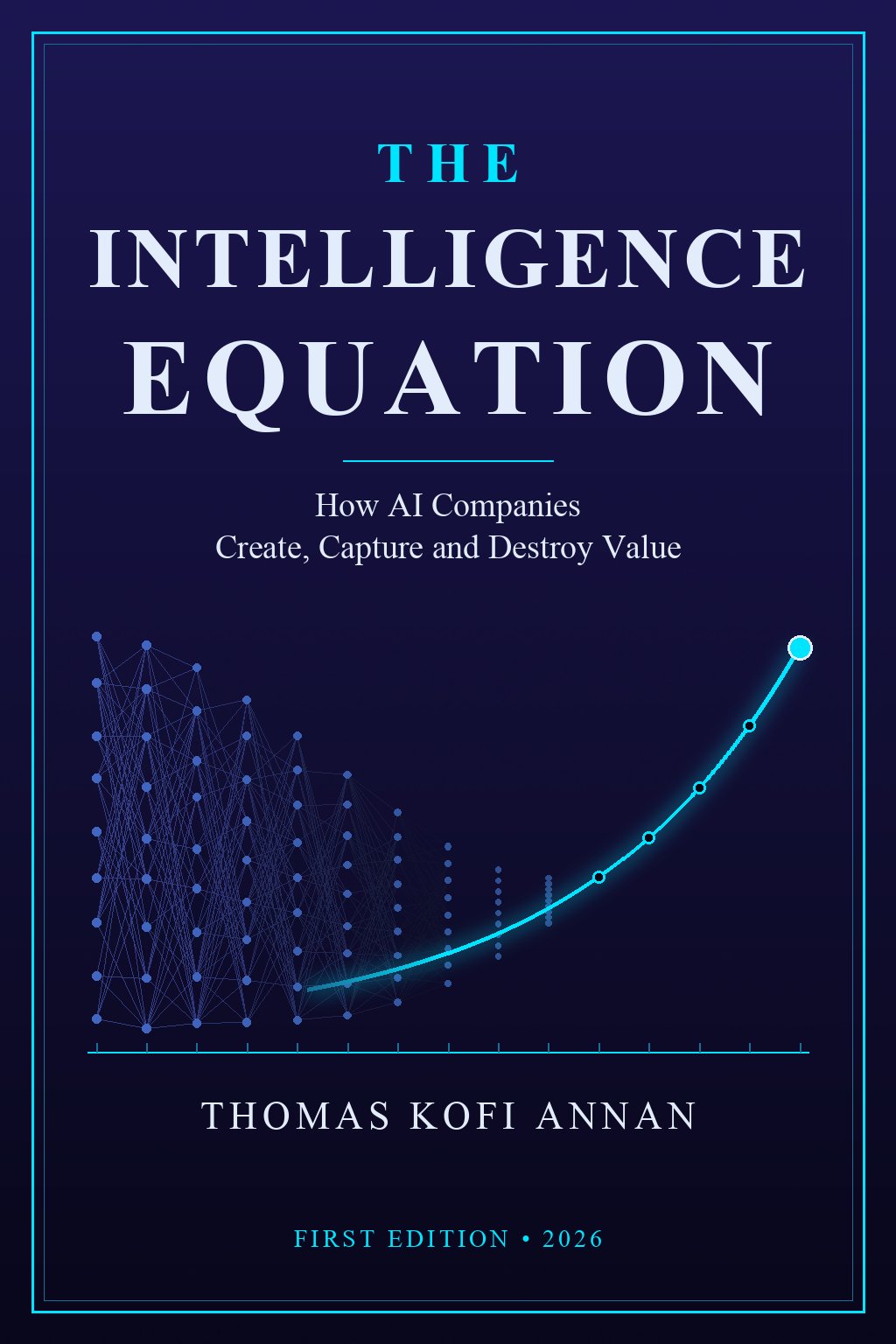
The Intelligence Equation cover

Artificial Intelligence · Volume 3 of the Equation Series

The Intelligence Equation

How AI Companies Create, Capture and Destroy Value
By Thomas Kofi Annan · First edition, 2026

Artificial intelligence became an industry in public in four years. On 30 November 2022 OpenAI released ChatGPT as a free research preview; by early 2026 it claimed about 900 million weekly users. Nvidia, which sells most of the chips the models run on, became the first company worth $4 trillion in July 2025 and $5 trillion that October. Read more

25
chapters
24
industry studies
100
companies
847
moves

Complete EditionBest value

Everything above, at the best price

PDF + EPUB + M4B

$99

Buy Complete Edition

The Book

25 chapters · ~65,000 words

PDF + EPUB, plus the narrative edition

$29

Buy The Book

Research Companion

24 studies · 100 profiles · 847 moves · ~1.4 million words

PDF + EPUB, plus the narrative edition

$59

Buy Research Companion

Audiobook

152 hr 60 min across 4 volumes

M4B (chaptered)

$39

Buy Audiobook

From the preface

The intelligence equation

Artificial intelligence became an industry in public in four years. On 30 November 2022 OpenAI released ChatGPT as a free research preview; by early 2026 it claimed about 900 million weekly users. Nvidia, which sells most of the chips the models run on, became the first company worth $4 trillion in July 2025 and $5 trillion that October. The four largest US cloud and platform companies spent about $400 billion of capital in 2025, mostly on data centres, chips and power, and guided to more than $700 billion for 2026. AI start-ups took about half of the world's venture funding in 2025 (reported). Some of this spending has created more value for users, faster, than any technology before it. Much of it will be lost, and in AI destruction can arrive as suddenly as success: Nvidia lost about $589 billion of market value in a single day in January 2025 when a small Chinese lab showed what a cheaper model could do, a London start-up valued at ~$1.5 billion entered insolvency less than three months after its founder stepped down in 2025, and a device that had raised ~$230 million was switched off less than a year after its first reviews.

The difference is rarely the quality of the research. This book argues that an AI company creates durable value only when four things are true at once, and that the factors multiply rather than add: if any is zero, the result is zero. It must have capability that survives real work, a system that does a job reliably enough, on evidence a buyer can check, that someone changes how they work and pays for it. It must have unit economics that hold at real usage, so that each token, query, seat or resolved task earns more than the compute it consumes when real customers, not pilots, use it. It must hold a position the next layer cannot route around, something scarce that keeps its supplier from taking the margin and its customer from switching. And it must have the capital and permission to last the cycle, the money to fund compute, chips and power, and the legal and political licence to operate, long enough to get paid. Around those four factors sit two forces that no company controls, the capital cycle and the rules, from copyright rulings and AI laws to export controls, which behave like weather: they do not decide whether a product works or earns its keep, but they decide how long a company can survive if it does not. Most of the failures in this book come from treating one factor as proven because another was, and most of the successes from a company that tested all four before its competitors did.

The twenty-five chapters develop that view. Part I explains why AI is not just software, how it became a business through seventy years of booms and winters, how the money from one query flows down the stack to the chip and the power plant, and why the evidence for a model's capability is so often weaker than it looks. Part II follows the markets one by one: chips, clouds and data centres, model labs, open models, tools and data, applications and consumer AI. Part III examines what it takes to build products that work, from inference economics and pricing to distribution and platform risk, data and copyright, agents and safety. Part IV covers capital and the AI cycle, acqui-hires and Big Tech, regulation, the geopolitics of chips and AI around the world. Part V turns to people: talent and research culture, and how to build an AI company. Part VI reads five cases for the decisions behind them. Each chapter opens with a case, explains the mechanics it illustrates, and closes by naming the factor of the equation on which its case turned.

The book · ~65,000 words

Contents

Each chapter has a free preview of its opening and section list.

AI Research Companion · Part I

24 industry studies

The companion opens with an in-depth study of each part of the industry, backed by 23 technical exhibits: worked examples, diligence checklists and case studies.

01Semiconductors and AI ChipsEvery AI product, from a chatbot answer to a self-driving car's next turn, ends as arithmetic on a chip. Modern AI is mostly one operation, multiplying large matrices of numbers, repeated trillions of times a second, and the companies that make chips which do this quickly, cheaply and at scale took the first and largest profits of the generative-AI boom. Nvidia reported data-centre revenue of ~$193.7 billion in the fiscal year to January 2026, up from ~$15 billion three years earlier, at gross margins in the low-to-mid 70s per cent (company filings). Behind that headline sits a supply chain with chokepoints at every stage: one company (ASML) makes the extreme-ultraviolet lithography machines that print leading-edge chips; one foundry (TSMC) manufactures nearly all advanced AI accelerators and owns most of the advanced-packaging capacity (CoWoS) that joins them to memory; three companies (SK Hynix, Samsung and Micron) make the high-bandwidth memory (HBM) every accelerator needs; and most of it happens in Taiwan and South Korea. An AI chip business is therefore an answer to five questions: how much useful work does the chip deliver per dollar and per watt, what software ecosystem makes that work easy to use, who controls the scarce inputs (wafers, packaging, memory, lithography), who are the few customers buying most of the output, and what happens when export controls, a product transition or a slowdown in data-centre spending arrives? This section explains how accelerators work and why memory and packaging, not only transistors, are the bottlenecks; maps the stack from lithography to rack-scale systems; covers GPUs, Nvidia's CUDA moat, challengers, custom ASICs (Google's TPU, Amazon's Trainium, the Broadcom-designed chips for Meta and OpenAI), HBM, foundry, packaging, lithography and networking; sets out margins and key numbers; and closes with cases, pitfalls and how practitioners think. A worked example compares the total cost of ownership of a merchant-GPU fleet with a custom-ASIC fleet, and a checklist sets out diligence questions by layer.+ 2 exhibits02Cloud, Data Centres and Compute InfrastructureChips do nothing until someone puts them in a building with power, cooling and a network, and rents or uses the result. That layer, the clouds and data centres, is where most of the AI industry's capital goes. The four largest US platform companies (Microsoft, Alphabet Google, Amazon AWS and Meta) spent roughly $230 billion on capital expenditure in 2024 and around $400 billion in 2025, and guided to roughly $700 billion or more for 2026 (company guidance, approximate; definitions differ). Amazon alone expected ~$220 billion of cash capex in 2026 and reported negative trailing free cash flow of ~$42 billion in October 2026 (company). Around the hyperscalers grew a second tier of neoclouds, GPU-specialist clouds such as CoreWeave, Nebius, Lambda and Crusoe, funded heavily with debt secured on GPUs and on contracts with a few customers; a third tier of colocation landlords such as Equinix; a fourth of infrastructure financiers; and a fifth of governments buying sovereign compute. The business has turned software companies into utilities: capital-intensive, power-constrained and dependent on long contracts. A compute business is therefore an answer to five questions: who is the end customer and how creditworthy is it, how long is the contract relative to the life of the chips, what does a unit of capacity cost to build and power, how fully is it used, and how is it financed? This section maps the layer, explains hyperscaler capex and cloud revenue, the physical data centre, neocloud economics, GPU pricing and utilisation, the depreciation debate, financing structures, colocation, power, sovereign compute and margins, then closes with cases, pitfalls and how practitioners think. A worked example models a stylized hyperscaler's capex, depreciation and free cash flow against its AI revenue, and a checklist sets out diligence questions for data-centre and neocloud businesses.+ 2 exhibits03Foundation Model LabsA foundation-model lab turns compute, data and research talent into a general-purpose model, and then sells access to that model through an API, subscriptions, enterprise contracts and its own products. A handful of labs sit at the frontier: OpenAI, Anthropic, Google DeepMind, xAI and Meta's superintelligence group in the US, with DeepSeek, Alibaba Qwen, Moonshot AI and others close behind in China and Mistral AI in Europe. They have grown revenue faster than any software companies in history: OpenAI from ~$3.7 billion in 2024 to ~$13 billion in 2025 (reported), and Anthropic from ~$4.6 billion for all of 2025 to ~$16.3 billion in the first half of 2026 alone (S-1, October 2026, reported). They have also raised and committed more capital than any private companies in history (OpenAI ~$122 billion at ~$852 billion in early 2026; Anthropic $65 billion at $965 billion in May 2026; compute commitments in the hundreds of billions of dollars each, reported), because their main input, computation, is bought in advance and their main product, a model, loses most of its value within a year or two as competitors and successors arrive. A lab's business model is therefore an answer to five questions: how fast is revenue growing and from which customers, what does each dollar of revenue cost to serve (inference), how much must be spent on training to stay at the frontier, how is that spending financed and committed, and what stops customers switching to a cheaper or open model? This section maps the labs, explains their revenue models, cost structure, training economics and release cadence, funding and compute deals, governance, distribution relationships, commoditisation pressure and legal overhangs, then sets out margins, key numbers, cases, pitfalls and how practitioners think. A worked example models a stylized lab's revenue against its compute burn under four scenarios, and a checklist sets out diligence questions.+ 2 exhibits04Open Source Models and the Open EcosystemAn "open" AI model is usually not open source in the software sense. What most labs release is open weights: the trained parameters, which anyone can download, run, fine-tune and often sell services on, under a licence that may or may not resemble a software open-source licence. The training data and much of the training code usually stay private. Open weights changed the economics of the whole stack. Each time a strong open model appears (Meta's Llama 2 in July 2023, Mistral's Mixtral in December 2023, Llama 3.1 405B in July 2024, DeepSeek-R1 in January 2025, Alibaba's Qwen3 in April 2025, OpenAI's gpt-oss in August 2025), the price that closed labs can charge for comparable capability falls, application builders gain a fallback against platform risk, and clouds, chip makers and inference hosts gain a product they can sell without paying a lab. But open weights do not pay for themselves: the releasing lab spends tens or hundreds of millions of dollars and gives away the result. An open-model strategy is therefore an answer to four questions: what does the releaser sell instead of the model, how open is the release really, who captures the value it creates, and how fast does the open frontier follow the closed one? This section explains the spectrum of openness, the licences, why each kind of releaser gives models away, the hub, hosting and fine-tuning economy around open weights (Hugging Face, inference clouds, local runtimes), the commoditisation pressure on closed labs, the shift of open leadership from the US to China in 2025–26, and the policy fights over whether open weights are a security risk or a public good.05Developer Tools, MLOps and Data InfrastructureBetween the model labs and the applications sits a layer of companies that sell the tools to build, feed, test, run and watch AI systems: data platforms (Databricks, Snowflake), data movement and governance (Fivetran, dbt, Informatica), retrieval and vector databases (Pinecone, Weaviate, Qdrant, pgvector), data labelling and expert data for training (Scale AI, Surge AI, Mercor), evaluation and observability (Braintrust, LangSmith, Arize, Datadog), experiment tracking and training tools (Weights & Biases), inference platforms and gateways (Together AI, Fireworks, Baseten, Modal, OpenRouter) and, the largest commercial category by 2026, AI coding tools (GitHub Copilot, Cursor, Claude Code, Codex, Devin, Replit). It is the "picks and shovels" layer, and like every picks-and-shovels layer it is a mix of a few very large winners and many companies whose product turned out to be a feature of someone else's platform. Its economics differ sharply by sub-layer: data platforms earn consumption revenue with ~70–80% gross margins; labelling marketplaces report gross billings of which most is paid to contractors; inference platforms resell GPUs at thin margins; coding tools resell model tokens and see their gross margin set by the labs that supply, and compete with, them. A developer-tools business is therefore an answer to four questions: is this a product or a feature, who owns the workload, how much of revenue is pass-through cost, and what happens when the model lab or the cloud ships the same thing? This section maps the layer, the business model of each part, the 2023–2026 consolidation wave (MosaicML, Tabular, Neon, Weights & Biases, Informatica, Windsurf, Cursor), the coding-tool boom, the gross-versus-net revenue trap in data labelling, landmark cases, pitfalls and how experts read the layer.06Enterprise AI Applications and CopilotsEnterprise AI applications are where the money spent on chips, clouds and models is supposed to come back as productivity, and they are where the evidence is thinnest. They come in four shapes: copilots that sit beside a worker inside software the worker already uses (Microsoft 365 Copilot, Gemini for Google Workspace, Salesforce's Einstein and Slack AI); agents that take whole tasks off a worker's hands (Salesforce Agentforce, ServiceNow's AI agents, Sierra and Decagon in customer service); knowledge and search layers that let an assistant reach a company's own documents (Glean, Microsoft Graph, Writer); and build-your-own platforms on which companies assemble internal tools from model APIs (Azure AI Foundry, Amazon Bedrock, Google Vertex AI, Palantir AIP). Enterprise generative-AI spending grew from about $11.5 billion in 2024 to about $37 billion in 2025 by Menlo Ventures' estimate (December 2025), and Microsoft reported more than 30 million paid Microsoft 365 Copilot seats in July 2026. Yet the most quoted study of the period, MIT NANDA's *GenAI Divide* (August 2025), reported that about 95% of organisations it studied saw no measurable return from their generative-AI pilots. The two facts are compatible: spending is buying access, and return depends on whether time saved is turned into lower cost or more output. An enterprise AI business is therefore an answer to four questions: whose workflow does it sit in, who owns the data it needs, how is it priced relative to the value it creates, and can the buyer prove that value after the pilot? This section maps the product types, the incumbent-versus-AI-native contest, pricing (seat, usage, agent and outcome), adoption and ROI evidence, procurement and governance, the role of integrators, landmark cases and pitfalls. A worked example computes a stylized copilot rollout's return, the seat-versus-usage choice and per-conversation versus per-resolution agent pricing, and a checklist sets out what a buyer or investor should ask.+ 2 exhibits07Consumer AI Products and AssistantsConsumer AI is the fastest-adopted technology product category on record and one of the hardest to make pay. ChatGPT went from launch on 30 November 2022 to an estimated 100 million monthly users in about two months (UBS estimate, February 2023), to 800 million weekly users by October 2025 (OpenAI) and to about 900 million weekly users in early 2026 (reported). Google's Gemini app reported more than 750 million monthly users in February 2026 and 950 million in July 2026 (Alphabet earnings calls), and Meta said Meta AI had about a billion monthly users across its apps in May 2025. But only a few per cent of these users pay, every free answer costs compute, switching between assistants costs nothing, and the platforms that own distribution (Apple, Google, Meta, Microsoft) can put their own assistant in front of users by default. Consumer AI therefore comes in five shapes: general assistants (ChatGPT, Gemini, Meta AI, Claude, Grok, Microsoft Copilot, DeepSeek), answer engines and AI search (Perplexity, Google AI Overviews and AI Mode, AI browsers), creative tools (Midjourney, Sora, Runway, Suno, ElevenLabs, Canva, Adobe Firefly), companions (Character.AI, Replika, Grok's companions), and devices (smart glasses, phones with on-device AI, and failed standalone gadgets such as the Humane AI Pin and Rabbit R1). A consumer AI business is an answer to four questions: how does it reach users without paying a platform toll, why do users come back, what does each free user cost to serve, and who pays — subscribers, advertisers, merchants or a partner? This section covers the product categories, the assistant race and its metrics, search and the publisher problem, subscriptions, advertising and commerce, retention, creative tools, companions and child safety, devices, landmark cases, pitfalls and how experts read the category.08Vertical AI: Legal, Finance, Media and ServicesVertical AI is AI built for one industry's work: a legal assistant that drafts and checks contracts, a research tool that reads every filing a bank analyst needs, a customer-service agent that resolves a retailer's refund requests, a video model trained for film studios, a scribe that writes a clinician's note. The pitch is that general models are now good enough at reading, writing and reasoning that the bottleneck has moved to workflow, data, trust and liability, which are specific to each industry, and that the prize is not the software budget of a profession but its labour budget. Law firms, banks, contact centres, agencies and studios spend far more on people than on software, so a product that does part of the work can, in principle, charge for outcomes rather than seats. 2024–26 produced the first large vertical AI companies on that thesis: Harvey (legal, valued at ~$15.5 billion in September 2026, reported), Sierra (customer service, ~$15.8 billion, May 2026), Decagon, Hebbia and AlphaSense (finance research), Runway and ElevenLabs (media), and, in healthcare, Abridge (covered in the Healthcare knowledge base). It also produced the first large cautionary tales: lawyers sanctioned for citing cases the AI invented, Klarna's partial retreat from AI-only customer service, and record-label and studio lawsuits against generative media companies. A vertical AI business is therefore an answer to four questions: whose labour does it replace or augment, who is liable when it is wrong, what proprietary data or workflow does it own that a general model and the industry's incumbent software vendor do not, and how is the value it creates split between vendor and customer? This section covers legal, finance, customer service and media in depth, links to the Healthcare and Finance knowledge bases rather than repeating them, and compares incumbents with AI-natives, pricing models and the evidence so far.09How Models Are Built: Data, Training and Scaling LawsA large language model is built in three stages. Pre-training teaches a neural network to predict the next token across trillions of words of text, code and images, and it is where most of the compute goes. Mid-training and post-training turn that raw predictor into a usable assistant: supervised fine-tuning on examples, preference training (RLHF and its successors), and, since late 2024, large-scale reinforcement learning on problems with checkable answers, which produced the "reasoning" models that think before they answer. Inference-time scaling, letting a model spend more tokens on a hard question, is the third lever. Behind all three sit scaling laws: empirical curves, first published by OpenAI researchers in January 2020 and corrected by DeepMind's "Chinchilla" paper in March 2022, showing that loss falls predictably as compute, parameters and data grow together. Those curves are the reason the industry spends tens of billions of dollars a year on training clusters: they turned model building from research into something closer to capital budgeting. They also expose the constraints. Compute doubles the cost of each step of improvement; the stock of high-quality public human text is finite (Epoch AI's central estimate is ~300 trillion tokens, which frontier training could fully use some time between 2026 and 2032, June 2024); synthetic data and distillation help but carry their own risks; and the economics of a model depend as much on what it costs to serve as on what it cost to train. This section explains the stages of model building, the scaling laws and their limits, the data supply chain (web crawls, licensed corpora, human labellers and synthetic data), distillation and its disputes, what the big training runs have cost, and how all of this shapes the business of the labs. A worked example computes a stylized compute and data budget from published scaling-law fits.+ 1 exhibit10Inference Economics and Unit CostsTraining a model is a one-off capital project; inference, running the model every time someone asks it something, is the recurring cost of the AI business and, by 2025–26, the larger part of the industry's compute bill. Its unit is the token, and its price has fallen faster than almost any price in economic history: Epoch AI found that the price of reaching a fixed level of performance fell by between 9x and 900x a year depending on the task, with a median of ~50x (March 2025), and OpenAI's list price for a GPT-4-class answer fell more than a hundredfold between March 2023 and July 2024. Yet AI companies' compute bills kept rising, and many AI applications run at gross margins far below software norms. Three forces explain the paradox. First, the price of *frontier* capability falls much more slowly than the price of *yesterday's* capability, and customers keep moving to the frontier. Second, reasoning models and agents multiply the tokens per task, by ten to a hundred times or more, through hidden chains of thought and long multi-step loops whose context grows with every step. Third, cheaper tokens unlock new uses (the Jevons effect), so total spending rises as the unit price falls. This section explains what a token costs to produce (prefill and decode, memory bandwidth, batching, the KV cache, quantisation, caching and specialised chips), how and why prices have fallen, how reasoning and agentic workloads blow up cost per task, what margins labs and applications actually earn, and how to read the numbers. Two companion files give a worked example of price-decline curves and reasoning-token cost blow-ups, and a checklist for diligence on inference costs.+ 2 exhibits11Business Models and Pricing for AIAI companies earn money in six main ways: they sell tokens through an API, subscriptions to consumers, seats to businesses, usage in the form of credits, actions or conversations, outcomes such as a resolved support ticket, and, increasingly, attention and commerce through ads and transaction fees inside assistants. The choice matters more than in ordinary software for two reasons. First, AI has a real marginal cost: every answer consumes compute (10), so a price that does not move with usage hands the vendor an open-ended bill. Second, AI increasingly does work that people used to do, so the natural reference price is not a software budget but a labour budget, and per-seat pricing, the standard of software-as-a-service for twenty years, shrinks when the software replaces the people who held the seats. This section maps the revenue models across the stack (chips and clouds aside), explains how each one handles variable cost and captures value, sets out the gross-margin structure from lab to application, examines the "wrapper" debate and the platform risk of building on someone else's model, and reviews the 2024–26 pricing experiments at OpenAI, Anthropic, Microsoft, Salesforce, Intercom, Cursor and others. A worked example prices one product four ways (token pass-through, seats, usage and outcomes) and stresses each against usage spikes, cheaper models, a reasoning upgrade and seat cuts; a checklist sets out questions to ask of any AI pricing model.+ 2 exhibits12Go-to-Market and Distribution for AI ProductsAn AI product reaches customers in one of six ways: through the product itself (a free tier or a viral output that sells the paid tier: product-led growth), through developers (an API or SDK that engineers adopt before procurement notices), through a sales team (enterprise selling with pilots, security reviews and proof-of-value), through a cloud or marketplace (AWS, Azure, Google Cloud and their marketplaces, where AI spend can be drawn from a customer's existing cloud commitment), through someone else's platform (app stores, operating systems, browsers, messaging apps, telecom bundles, default-placement deals), or inside an incumbent's existing product (bundling: Copilot in Microsoft 365, Gemini in Workspace and Android, Einstein and Agentforce in Salesforce). The striking fact of 2023–26 is how fast the first two routes worked: coding tools and app builders reported going from launch to hundreds of millions or billions of dollars of annualised revenue in one to three years, numbers that classic SaaS took a decade to reach. The equally striking fact is how fragile that speed can be. A product that grows on someone else's model, someone else's platform and someone else's distribution can lose all three in one negotiation, as Windsurf discovered in 2025. Distribution in AI is therefore an answer to four questions: who decides to adopt (a user, a developer, a buyer, a platform owner), what does the first useful experience cost the vendor in compute, who owns the customer relationship after adoption, and what stops an incumbent with existing distribution from shipping the same feature as a bundle? This section maps the routes to market, the economics and evidence for each, the platform and bundling dynamics that decide who wins, landmark cases, pitfalls and how practitioners think about distribution. Pricing and gross margins are covered in 11; the cost of serving free users is in 10.13Agents, Automation and the Future of WorkAn agent is a model that does not just answer but acts: it plans a sequence of steps, calls tools (search, code execution, a browser, a company's APIs), observes the results and keeps going until a goal is met or it gives up. Chatbots sell answers; agents sell completed work. That shift, which the industry pushed hard from late 2024, changes the business question from "how much is a better answer worth?" to "how much of a job's labour cost can software take?", a pool of money far larger than any software budget. It also changes the risk. A wrong answer is read by a human; a wrong action is executed. Agents in 2025–26 became genuinely useful in a few domains, above all software engineering and customer support, where the work is digital, the steps are checkable and the cost of an error is bounded. Elsewhere they remained unreliable over long tasks, expensive to supervise and hard to integrate. The labour-market evidence is mixed and early: large-sample studies through 2025 found no economy-wide disruption, but some found falling employment for young workers in the most exposed occupations, and several large companies attributed headcount cuts to AI. The subject is therefore an answer to four questions: what can an agent reliably complete without a human, what does a completed task cost compared with a person, who carries the risk when the agent errs, and what happens to the jobs, firms and service industries whose work it takes over? This section explains how agents are built, why reliability compounds, the products and standards of 2024–26, the "services-as-software" thesis, the economics of a deployed agent, the labour-market evidence and its limits, landmark cases, pitfalls and expert framing. Pricing models for agents (per resolution, per outcome) are covered in 11; evaluation and safety of agents in 14.14AI Safety, Alignment and EvaluationEvery AI company has to answer two questions about its product: what can it do, and what will it do? The first is a question of capability; the second is a question of behaviour, which includes doing what the user and the company intend (alignment), refusing what it should refuse, telling the truth, not causing harm when misused, and not taking unintended actions as an agent. Evaluation is how both questions are answered: benchmarks, red-teaming, dangerous-capability tests, product-specific test sets and monitoring in production. Evaluation is also a commercial instrument. Benchmark scores sell models, safety commitments win enterprise and government trust, and the absence of evidence about behaviour becomes a liability when something goes wrong, as lawsuits over chatbot interactions with teenagers showed in 2024–26. The field's central difficulty is that the evidence is weaker than the claims: public benchmarks saturate within a year or two, leak into training data, and reward optimising for the test; red-teaming finds problems but cannot prove their absence; and frontier labs write, grade and revise their own safety frameworks, with legal transparency duties only beginning in 2025–26 (the EU AI Act's general-purpose model rules, California's SB 53, New York's RAISE Act). This section explains the purposes and methods of evaluation, the limits of benchmarks, how alignment is done and where it fails, red-teaming and dangerous-capability testing, the labs' frontier safety frameworks, the emerging legal regime, the incidents that shaped the field, the business of safety, landmark cases, pitfalls and how practitioners think about it. Regulation in general is in 19; agent reliability is in 13.15Data, Copyright and Content LicensingEvery large AI model is built from other people's work: books, news, code, photographs, songs, forum posts and the open web. For most of the deep-learning era nobody asked permission or paid. Since late 2022 that has produced the largest body of copyright litigation the technology industry has seen: about fifty US suits by September 2025 (tracker count, verify) plus test cases in the UK, Germany, India and Canada. The first rulings, in 2025, split the problem in two. Training on lawfully acquired works was held to be fair use in two San Francisco cases (Bartz v. Anthropic and Kadrey v. Meta, June 2025). Acquiring works from pirate libraries was not excused, and that produced the largest copyright settlement in US history: $1.5 billion from Anthropic, about $3,000 per work on a list of ~482,000 works, finally approved in July 2026 (reported). A non-generative competitor lost (Thomson Reuters v. Ross, affirmed on appeal September 2026). A German court held that a model which memorised lyrics contained copies of them (GEMA v. OpenAI); an English court held that Stable Diffusion's weights did not (Getty v. Stability AI), both in November 2025. Alongside the suits a licensing market has grown: Reddit with Google and OpenAI, News Corp with OpenAI (reported at more than $250 million over five years), Amazon with The New York Times (reported at $20–25 million a year), Disney's $1 billion investment in OpenAI with a character licence for Sora (December 2025), and record-label suits against Udio, and Warner's against Suno, turned into licences (UMG and Sony filed a second suit against Suno on 18 September 2026, reported). This section explains the law in business terms (why acquisition and outputs matter more than training), the main cases and their status at November 2026, the licensing market and its pricing, opt-outs and technical controls, the EU, UK and Asian regimes, and how rights risk enters a lab's or app's economics. A worked example compares licensing with litigation exposure, and a checklist sets out provenance questions.+ 2 exhibits16Energy, Power and the Physical Limits of AIArtificial intelligence runs on electricity, and by 2025 the electricity had become harder to get than the chips. A single frontier training cluster now draws as much power as a mid-sized city: xAI's Colossus in Memphis, Crusoe's Stargate campus for OpenAI and Oracle in Abilene, Texas (~1.2 GW planned, plus a ~900 MW expansion leased by Microsoft), and Meta's Hyperion in Louisiana are each measured in hundreds of megawatts to gigawatts. The International Energy Agency estimated that data centres used ~415 TWh in 2024, about 1.5% of world electricity, and projected ~945 TWh by 2030, with AI the main driver (Energy and AI, April 2025). In the United States, Lawrence Berkeley National Laboratory put data centres at ~176 TWh, or 4.4% of national electricity, in 2023, rising to 6.7–12% by 2028 (December 2024). The four largest US cloud and platform companies guided to roughly $720–750 billion of combined capital spending for 2026 (company guidance, July–October 2026, reported), much of it for buildings and the power to run them. The result has been an unprecedented scramble: restarting shut nuclear plants (Three Mile Island Unit 1 for Microsoft, Duane Arnold for Google), 20-year contracts with existing reactors (Amazon_AWS with Talen at Susquehanna, Meta with Constellation and Vistra), bets on small modular reactors that will not deliver before about 2030, gas turbines on site, sold-out turbine factories, record capacity prices in the largest US grid market (PJM), large-load queues of hundreds of gigawatts in Texas, and political fights over who pays for the grid. This section explains how much power AI uses and why, what a data centre's power chain looks like, the economics of power in an AI campus (power is a small share of cost but the binding constraint on time), the supply options (grid, gas, nuclear, renewables plus storage), the grid bottlenecks (interconnection, transmission, transformers, turbines), water and local politics, efficiency gains and the Jevons argument, and the physical limits that power shares with chips, memory and packaging.17AI Investing, Valuations and the Capital CycleNo technology wave has absorbed capital as fast as generative AI. In 2025 roughly half of all venture dollars raised worldwide went to AI companies (~$212bn of ~$425bn on Crunchbase's count, reported January 2026). Two private labs reached valuations near or above $850bn in 2026: OpenAI at $852bn post-money in March and Anthropic at $965bn in May (both reported). The four largest US cloud and platform companies were on course to spend roughly $700–800bn of capital expenditure in calendar 2026, most of it on data centres, chips and power (company guidance and analyst roll-ups, reported October 2026; verify). Much of this money flows in a circle. Chipmakers invest in labs that buy their chips. Clouds invest in labs that rent their capacity. Neoclouds borrow against contracts with customers that are themselves funded by the neoclouds' suppliers. This section explains where AI capital comes from, how mega-rounds and "circular" compute deals are structured, how the public-market AI trade works, how valuations are argued for, what history says about investment booms built on real technology, and how an experienced investor separates the parts of the cycle that are building durable value from the parts that are financing each other.+ 2 exhibits18M&A, Acqui-hires and Big Tech PartnershipsIn most technology cycles the big incumbents buy the start-ups that threaten them. In AI they mostly did not, at least at first. Between 2019 and 2025 the most important deals between Big Tech and AI labs were minority investments bundled with cloud contracts (Microsoft–OpenAI, Amazon–Anthropic, Google–Anthropic), and a new structure, the licence-and-hire or "reverse acqui-hire", in which a giant pays a start-up a large licence fee, hires its founders and most of its researchers, and leaves the company itself behind. Microsoft did this with Inflection (March 2024), Amazon with Adept and Covariant (2024), Google with Character.AI (2024) and Windsurf (2025), Meta in a different form with a $14.3bn stake in Scale AI (2025), and Nvidia with Groq (~$20bn, December 2025). These deals were designed to be fast and to avoid the merger review a full acquisition would trigger, and from 2024 competition authorities in the US, UK and EU began to treat them as mergers in substance. Then, from 2025, conventional M&A came back on a scale the industry had not seen: Google bought Wiz for $32bn, IBM bought Confluent for ~$11bn, SpaceX absorbed xAI and agreed to buy Cursor for $60bn, and Nvidia agreed to buy Hugging Face for ~$12.9bn (2026, reported). This section explains the deal types, the economics for founders, investors and employees, the antitrust response, and how an experienced dealmaker reads an AI partnership.19Regulation and PolicyAI regulation in 2026 is a patchwork stitched from four different philosophies. The European Union passed the world's first comprehensive AI statute, the AI Act (in force 1 August 2024), which bans a short list of practices, sets duties for "high-risk" systems and for general-purpose models, and fines up to 7% of global turnover; in July 2026 it then delayed the high-risk rules to December 2027 and August 2028 through a "Digital Omnibus" amendment. The United States has no federal AI statute. Its federal government moved from the safety-oriented executive order of October 2023 to a deregulatory, "win the race" posture in 2025, and in December 2025 ordered federal agencies to challenge state AI laws, while the states themselves passed hundreds of AI bills, including California's frontier-model transparency law (SB 53, in force January 2026), New York's RAISE Act (effective January 2027), Texas's TRAIGA (January 2026) and Colorado's pioneering, repeatedly delayed and finally rewritten AI Act. China regulates AI through a fast-moving sequence of targeted rules administered by the Cyberspace Administration of China, covering recommendation algorithms, deepfakes, generative AI, content labelling and, from July 2026, human-like "companion" AI, with security and content control at their core. The United Kingdom chose a "pro-innovation" approach that relies on existing regulators and a well-funded AI Security Institute, and had still not introduced a promised frontier-AI bill by late 2026. This section explains each regime, the fights over federal preemption in the US, the economic logic of AI regulation, what compliance actually costs and involves, and how an experienced policy or compliance lead reads the next move.20Geopolitics, Export Controls and US–China CompetitionAI is the first general-purpose technology whose key input is made in a handful of places that governments can count. The most advanced AI chips are designed mostly in California, fabricated mostly by one company in Taiwan, packaged with memory made mostly in South Korea, and printed on machines made only in the Netherlands. That concentration turned chips into an instrument of state power. From October 2022 the United States used export controls to cap the computing power China could buy and the chipmaking tools it could import, and it widened those rules in October 2023, December 2024 and January 2025. Then policy turned. In 2025 the Trump administration scrapped the global "AI diffusion" rule, banned and then re-licensed Nvidia's China chip in exchange for a share of revenue, and in December 2025 offered the more powerful H200 to China for a 25% cut. Beijing answered with rare-earth controls, an antitrust case against Nvidia and instructions to its own companies to buy Chinese chips instead. Meanwhile Huawei and SMIC kept shipping chips the rules were meant to prevent, smugglers moved servers through Southeast Asia, Chinese labs such as DeepSeek showed that strong models could be trained on restricted hardware, and the Gulf states bought their way into the top tier of compute. This section explains the chokepoints, the rules and how they changed, China's response, the smuggling problem, Taiwan risk, the Gulf deals, and how an investor, founder or policymaker should read the next move.+ 2 exhibits21History of AI as a BusinessArtificial intelligence has been "about to arrive" for seventy years, and the business built around it has boomed and crashed several times before the current cycle. A summer workshop at Dartmouth in 1956 named the field and promised that a few months' work would make real progress on machine intelligence. Government money, mostly from the US defence research agency, carried the field through the 1960s, until reports in Britain and America found little to show and funding was cut. Expert systems turned AI into an industry in the 1980s, with specialised Lisp machines, venture-backed start-ups and Japan's national Fifth Generation project, and that industry collapsed in 1987–93 when cheaper computers and brittle software caught up with it. Statistical methods quietly took over speech, search and advertising in the 1990s and 2000s, without much talk of "AI". Then three things arrived together around 2012: large labelled datasets, graphics chips that could train neural networks fast, and a handful of researchers who had kept faith with those networks. The deep-learning results of 2012 started a bidding war for talent, the transformer of 2017 gave the field a general architecture, and ChatGPT in November 2022 turned research into the fastest-adopted consumer product to that date and set off the largest capital cycle in technology history. This section traces that sequence, explains the business models each era produced and the patterns that keep repeating, and shows how the history helps separate a real shift from a re-run of an earlier hype.22Talent, Research Culture and Building an AI CompanyIn most industries capital is scarce and people are replaceable. At the frontier of AI in 2023–26 the reverse often held: money was abundant and a few hundred researchers who knew how to train and tune the largest models were not. That scarcity produced pay packages reported in the hundreds of millions of dollars, licence-and-hire deals in which Big Tech paid billions mainly for teams, seed rounds of $1–2bn for labs with no product, and a summer in 2025 when Meta's chief executive personally recruited rivals' researchers. It also made governance fragile. OpenAI's board fired its chief executive in November 2023 and reversed itself within five days when nearly all its staff threatened to leave, and the episode changed how every lab thinks about mission, control and retention. This section explains how the AI talent market works and why it pays what it does, how labs are governed and why their unusual structures exist, how research culture differs from product culture, and how founders build AI companies, from the team to compute access and the order of hires, with the 2025–26 cases as evidence.23AI Failures, Hype Cycles and BubblesArtificial intelligence has failed as a business more often, and more publicly, than almost any other technology. It has done so in a small number of ways, again and again. A striking demonstration persuades people that a general capability exists. Money and expectations run ahead of what the system can reliably do in messy real settings. The gap between demo and deployment is filled with human labour, optimistic accounting or simple waiting. Then the money runs out before the capability arrives. This happened to machine translation in the 1960s, to expert systems and LISP machines in the 1980s, and to IBM's Watson Health in the 2010s. It happened to the self-driving programmes of 2016–2024, from Uber ATG and Argo AI to GM's Cruise, and to Zillow's algorithmic home-buying in 2021. The generative-AI boom added its own cases: Humane's AI Pin, the Rabbit R1, the reset at Jasper and the collapse of Builder.ai in 2025. There were also start-ups whose "AI" turned out to be people, and the first enforcement actions against "AI washing". Each failure also had survivors who learned from it. Waymo outlasted Cruise, Opendoor outlasted Zillow Offers, and the deep-learning researchers who kept working through the second AI winter built the industry of the 2020s. This section explains how AI hype cycles work and walks through the major failures from the first AI winter to 2026. It sets out the recurring mechanics of demo-driven fundraising and "humans behind the curtain", places the 2023–26 boom alongside earlier technology bubbles, and explains how an experienced investor, operator or journalist reads the early signs.+ 2 exhibits24Global AI Markets and Emerging EconomiesAt the frontier, AI is a two-country industry. The United States and China between them hold most of the world's AI compute, almost all of its frontier labs and the great majority of its AI capital. On the Stanford AI Index's count, US private AI investment in 2024 was ~$109bn, against ~$9bn for China and ~$4.5bn for the UK (reported April 2025). Every other country has had to choose a position. Some try to build their own models and champions, as France does with Mistral and India does with its IndiaAI Mission. Some buy access to American or Chinese models and focus on adoption. Some host other people's compute in return for capital and influence: the UAE and Saudi Arabia offer cheap energy and sovereign money in exchange for American chips. Some specialise: Taiwan and the Netherlands in chips, Kenya and the Philippines in data work, Israel and Canada in research talent. Africa has ~18% of the world's people and well under 1% of its data-centre capacity (reported estimates). It meets AI first as a supplier of data labour and a market for consumer apps. Its own opportunities are local-language data and models, low-cost distribution through mobile money and messaging, and a few compute projects. This section maps the global AI market region by region: China, Europe, the Gulf, India, the rest of Asia, Latin America and Africa. It explains what "sovereign AI" means in practice and what it costs, and looks closely at Ghana. It sets out the patterns that decide where value is created outside the two leaders, and how an experienced investor, founder or policymaker in an emerging economy thinks about them.+ 2 exhibits

AI Research Companion · Part II

100 companies, 847 strategic moves

A profile of each company, followed by its defining moves year by year from 1984 to 2026: what was decided, why, how it was financed, and what happened next.

Browse all 100 →

Audiobook & narrative editions

152 hr 60 min of narration

Both volumes are rewritten as narrative editions that read straight through, in long-form prose instead of tables. The audiobook is narrated from those editions as chaptered M4B files that play in Apple Books, VLC, BookPlayer and most audiobook apps.

  • The Book15 hr 35 min
  • Companion Volume 1 - Industry Studies23 hr 53 min
  • Companion Volume 2 - Companies A to L55 hr 4 min
  • Companion Volume 3 - Companies M to Z and Timeline58 hr 27 min

Appendix C

Glossary: 96 terms

Read the full glossary →
Accelerator
A chip designed for the arithmetic of training and running models: a GPU, a TPU or another custom design.
Acqui-hire
A purchase made mainly for a company's people; see licence-and-hire.
Agent
A model in a loop that plans a step, calls a tool, reads the result and continues until the goal is met or it gives up. Agents sell completed work rather than answers.
AI Act
The European Union's comprehensive AI statute, in force from 1 August 2024, which sorts AI by risk and attaches duties to providers and deployers whose systems or outputs are used in the EU.
AI Diffusion Framework
The US export rule of January 2025 that sorted countries into three tiers with caps on advanced chips; its rescission was announced on 13 May 2025.
AI winter
A period in which funding and confidence in AI collapsed after promises outran results, as in the 1970s and after the expert-systems boom.
API
Application programming interface: the metered service through which developers send requests to a model and pay, usually per token.
ARR
Annual recurring revenue: contracted subscription revenue expressed as a yearly figure. In AI it is often used loosely for run-rate.

From the blog

Read before you buy

All 9 articles →

The Intelligence Equation

Learn the framework from the book. Test it against the companion.

Choose an edition

More in the series