Landed cost is the total cost of getting one unit of a product from the factory to your warehouse: the factory price plus freight, port and inland charges, duties, customs fees, brokerage, insurance and the cost of the money tied up while the goods are in transit. To calculate it, add each of those costs for a whole shipment and divide by the number of units. Then compare the result with your selling price, because the landed cost, not the factory price, decides whether a product makes money.
In 2025–26 the factory price was often not the number that moved most. Tariffs changed under three different legal authorities in eighteen months, and the spot rate to ship a forty-foot container from Shanghai to Los Angeles roughly tripled in a year, to about $7,514 on 29 October 2026 on Drewry's World Container Index (reported). Importers that knew their landed cost by product and origin could reprice or resource quickly. Those that knew only their factory prices found out from their margins.
The landed cost formula
For one shipment:
Landed cost per unit = (product cost + freight + port and inland charges + duties + customs fees + brokerage + insurance + transit carrying cost) ÷ units
| Component | What it is | How to calculate it |
|---|---|---|
| Product cost | The factory price under your purchase terms, usually free on board (FOB) at the origin port | Units × FOB price |
| Freight | Ocean rate per container, or truck rate per load | From your contract or a dated spot quote, with the unit stated |
| Port and inland | Terminal charges, drayage, chassis and delivery to your warehouse | Per container |
| Duties | Each tariff line in the stack, as a percentage of customs value | Customs value × each rate |
| Merchandise processing fee (MPF) | 0.3464% of value, minimum $34.58 and maximum $670.86 per formal entry from 1 October 2026 | Per entry |
| Harbor maintenance fee (HMF) | 0.125% of value, ocean cargo only | Per entry |
| Brokerage | The licensed customs broker's fee | Per entry |
| Insurance | Cargo cover, often a fraction of a percent of value | Value × rate |
| Transit carrying cost | Capital tied up while you own goods in transit | Value × annual carrying rate × days ÷ 365 |
Two conventions trip people up. First, US duty is charged on transaction value, which excludes international freight and insurance, so it is effectively an FOB basis; the EU uses CIF. Second, if you buy FOB, you own the goods from the moment they leave the factory, so every extra day on the water is your cost.
Step 1: Fix the purchase terms
Under the Incoterms rules, buying FOB at the origin port makes you responsible for the ocean freight and everything after it. Most large US importers buy this way to control timing, which also means freight swings land on their books. Buying "delivered duty paid" moves those costs to the seller, who prices them in. Know which you have before you add anything. Chapter 3 on who pays to move a box traces each hand-off.
Step 2: Classify the product and build the tariff stack
Every import is classified in the Harmonized Tariff Schedule of the United States. The first six digits follow the international Harmonized System; the US adds digits to eight and ten. Classification decides the duty, and two codes a digit apart can carry very different rates. Additional duties sit in Chapter 99 of the schedule, so the tariff on one product from one country on one date is a list of lines, not one rate.
As of November 2026, a stack can include:
- the most-favored-nation (MFN) rate, or a preference rate under a free-trade agreement such as USMCA;
- Section 301 duties on China from the 2018–19 lists (7.5–25%, raised on strategic goods in 2024);
- the Section 301 action in force from 24 July 2026 on 60 economies, at 10% for 17 economies including Mexico and Canada, 12.5% for others including China and Vietnam, and product-specific rates for the EU, Japan, Korea, Taiwan and Switzerland (USTR, reported; check the annexes per product);
- Section 232 duties on steel, aluminum, copper, autos, trucks, lumber, furniture, chips and patented pharmaceuticals, whose goods are excluded from the 2026 Section 301 action;
- antidumping and countervailing duties for specific producers.
The stack changes often. The tariffs imposed under IEEPA from 2025 were struck down by the Supreme Court on 20 February 2026; a 10% Section 122 surcharge ran from 24 February to 24 July 2026; then the new Section 301 regime began. Use the Federal Register notice and CBP's guidance as the authority, and treat an announced rate as different from one in force. The full sequence is in the industry study of trade policy, tariffs and customs.
Step 3: Price the freight and the time
Use a freight rate with its unit, lane, source and date, and work out freight per unit by dividing by units per container. Then price the time. A product that spends 40 days in transit instead of 30 carries ten more days of capital cost, and a disrupted route adds both days and uncertainty. Our guide on how to read container shipping rates explains why the spot index may not be what you pay.
A worked landed cost example: China vs Vietnam vs Mexico
The book's Appendix A follows one forty-foot container of an invented household product, 2,400 units, into a US distribution center. The retailer sells each unit for $29.99 and targets a 45% gross margin. A Chinese factory charges $12.00 FOB, a Vietnamese one $13.20 and a Mexican plant $14.50. Ocean freight is $2,000 per container from China at a base rate and $7,500 at a crisis rate, with $1,800 per container for port, drayage and inland delivery; Mexican goods move by truck at $3,200 plus $600 of delivery. Duty stacks are illustrative: China pays 5% MFN plus 25% and 12.5% under Section 301, or 42.5%; Vietnam 5% plus 12.5%; USMCA-qualifying Mexican goods are assumed duty-free, as reported for the 2026 regime but not yet confirmed. Fees include MPF, HMF on ocean cargo, a $150 broker fee, 0.3% insurance and a 25% annual carrying cost for days in transit.
| Stylized case | FOB per unit | Freight per unit | Duties and fees per unit | Carrying cost per unit | Landed cost per unit | Retailer margin at $29.99 |
|---|---|---|---|---|---|---|
| China, base freight | $12.00 | $1.58 | $5.26 | $0.25 | $19.08 | 36% |
| China, crisis freight | $12.00 | $3.88 | $5.26 | $0.33 | $21.46 | 28% |
| Vietnam, base freight | $13.20 | $1.71 | $2.47 | $0.32 | $17.70 | 41% |
| Vietnam, crisis freight | $13.20 | $4.08 | $2.47 | $0.41 | $20.16 | 33% |
| Mexico, USMCA-qualifying, truck | $14.50 | $1.58 | $0.16 | $0.06 | $16.30 | 46% |
| Mexico, non-qualifying, truck | $14.50 | $1.58 | $2.33 | $0.06 | $18.47 | 38% |
Stylized; illustrative duty stacks, not the rate for any real tariff code.
Three lessons come out of the table. The tariffs, not the freight, do most of the damage: from China, freight adds $1.58 a unit at the base rate while duties and fees add $5.26. The cheapest factory is not the cheapest source: a Mexican plant charging 21% more than China lands its unit for less, if it qualifies under USMCA. And the rules of origin are worth as much as the factory price: the same Mexican product lands at $18.47 if it does not qualify. Only the qualifying Mexico case clears the 45% margin target.
Step 4: Add what the table leaves out
Real imports are messier. The example ignores antidumping duties, Section 232 duties on metal content, exchange rates, minimum order quantities, quality failures and the cost of qualifying a new supplier. Inventory matters too. The book's safety-stock example finds that a product sourced from Asia by ocean needs about 12.8 weeks of supply at a 95% service level, against about 4.4 weeks from a Mexican supplier by truck, because lead-time variability, not distance alone, drives safety stock. The nearshore supplier saves carrying cost that belongs in the comparison. Our explainer on the bullwhip effect shows why shorter lead times also steady the whole chain.
Step 5: Look at legal ways to reduce duty
The research works a second stylized example of an importer buying Vietnamese goods through a Hong Kong trading company at $20.00 a unit, while the factory is paid $16.00, with a 15.9% duty stack. It compares three legal tools:
| Tool | What it does | Stylized saving vs baseline |
|---|---|---|
| First-sale valuation | Uses the factory-to-middleman price as customs value, if it was a bona fide sale for export at arm's length | About $746,000 a year |
| First sale plus drawback | Adds refunds of up to 99% of duties on goods later exported or destroyed | About $1.08 million a year |
| Foreign-trade zone only | Defers duty until goods leave the zone, and avoids it on re-exports | About $416,000 a year |
These programs need a licensed customs broker and often trade counsel, and their treatment under the 2026 Section 301 action should be checked against current CBP guidance.
Why landed cost drives nearshoring
Mexico became the largest source of US goods imports in 2023 and stayed first in 2024 and 2025 (Congressional Research Service). The landed cost arithmetic explains part of the shift. A move buys lower duties when goods qualify under USMCA, shorter transit, smaller safety stock and less exposure to ocean shocks. It also carries a political option: on 1 July 2026 the US declined to confirm USMCA's 16-year extension, so the agreement now faces annual reviews. Railroads such as Canadian Pacific Kansas City, with a single-line network into Mexico, are bets on that trade. The industry study of nearshoring, friend-shoring and China plus one sets out the evidence.
Tariffs can also flow back. After the IEEPA ruling, importers claimed refunds: Walmart reported about $2.9 billion received in the quarter to July 2026 (reported), and Target a pre-tax benefit of about $994 million in the same period (company). Customs brokers such as Flexport built refund calculators to win that work.
Landed cost and the flow equation
The Flow Equation argues that a supply-chain business creates durable value only when cost to serve, density, reliability and capital matched to the cycle are all present, because the factors multiply. Landed cost is the first factor made concrete: the full cost of serving a customer, not the factory invoice. Tariffs and freight shocks are the outside weather the book describes, and a sourcing decision made on factory price alone mistakes one line of the cost for the whole. For the economics of the industry around these decisions, see our guide to the logistics industry business model.
The takeaway
Calculate landed cost per unit, by product and by origin, with every assumption dated: purchase terms, classification, the full tariff stack, freight with its unit and date, fees, insurance and the cost of time in transit. In the stylized example, tariffs moved the answer more than freight did, and a rule of origin was worth more than a 21% difference in factory price. Recalculate whenever the legal authority behind a tariff changes, which in 2026 happened twice. Chapter 19 of The Flow Equation explains how tariffs, trade rules and customs reshape these numbers.
Frequently asked questions
What is included in landed cost?+
The factory price plus everything needed to get the goods to your door: ocean or truck freight, port and inland charges, duties, customs fees such as the merchandise processing fee and harbor maintenance fee, brokerage, insurance and the cost of the money tied up in the goods while they travel.
Is US import duty charged on the FOB value or the CIF value?+
The US normally values imports on transaction value, which excludes international freight and insurance, so duty is effectively charged on an FOB basis. The EU, by contrast, uses a CIF basis that includes freight and insurance.
What is the merchandise processing fee for fiscal 2027?+
The merchandise processing fee is 0.3464% of the entered value, with a minimum of $34.58 and a maximum of $670.86 per formal entry from 1 October 2026, per CBP's Federal Register notice of July 2026.
Who pays the tariff on imported goods?+
The importer of record pays the duty to US Customs and Border Protection when the goods enter the country, not the exporting country. Whether the importer passes that cost to customers or absorbs it in its margin is a business decision.
Go deeper in The Flow Equation
Chapters
Industry studies
Company profiles
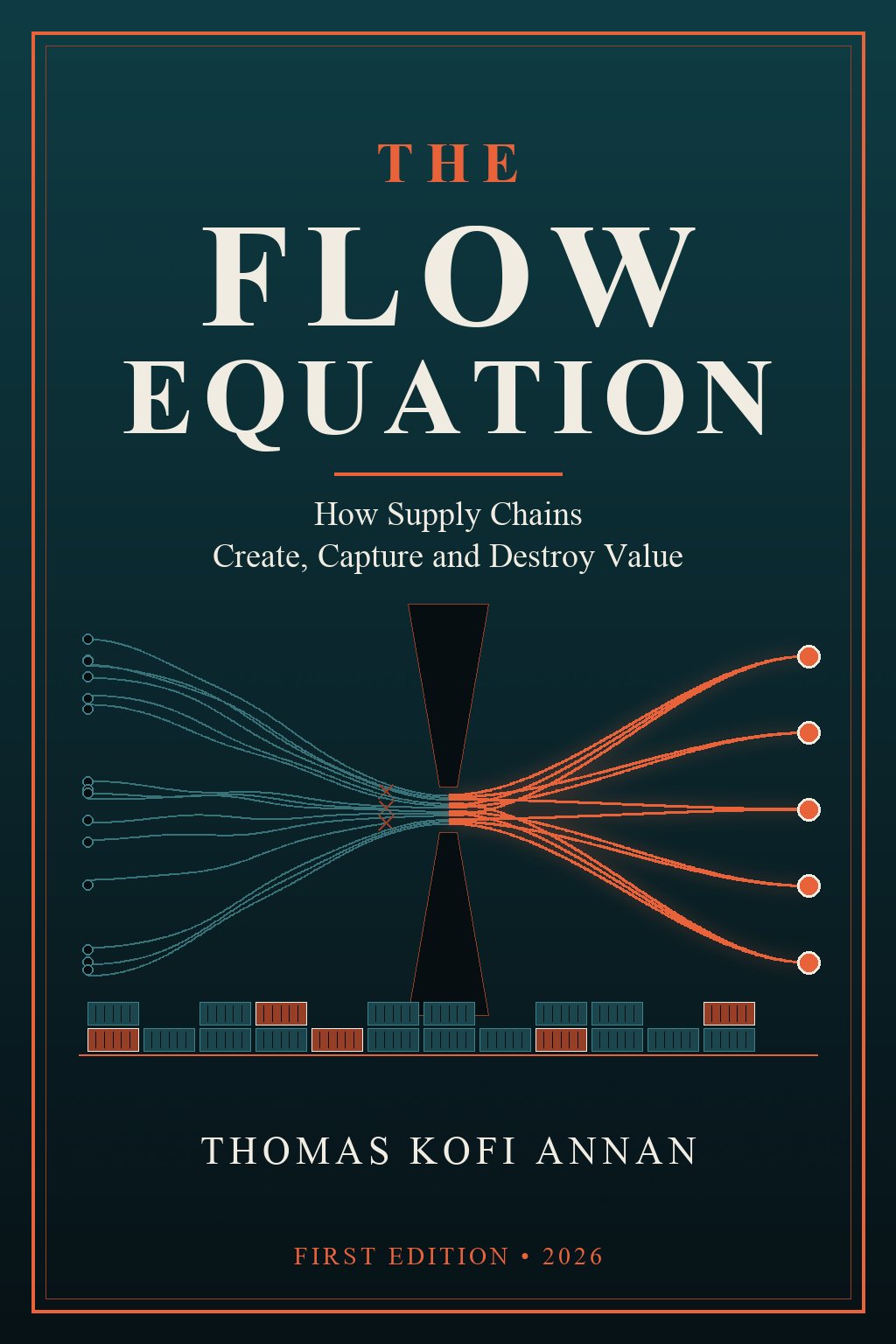
From the research behind The Flow Equation
How Supply Chains Create, Capture and Destroy Value
25 chapters, 24 industry studies, 100 companies and 848 strategic moves.
See the bookEducational content, not investment, legal, tax, medical or engineering advice. Figures marked “reported” come from filings and published sources that have not been independently audited.