To raise a seed round, you need a live product and early evidence that customers want it, a clear milestone the money will reach in 18 to 24 months, and a lead investor who will set the price and terms. In the US in 2024–26, a typical seed round was about $2 million to $6 million, founders sold about 15–25% of the company, and most early money arrived on post-money SAFEs. The round succeeds if it buys enough progress to raise a Series A.
That last point is harder than it was. Carta's data show about 12% of the Q1 2022 seed cohort reaching Series A within two years, and about 25% after three years, against 30% or more within two years for 2018–2020 cohorts. Raising the seed is the first test; raising it so that the next round is possible is the real one.
What does a seed round need to prove?
Stages are best defined by what each round proves, not by check size, because labels inflate in hot markets.
| Stage | What the company has | What the money proves | Typical US round, 2024–26 |
|---|---|---|---|
| Angel | Founders, an idea, perhaps a prototype | The founders can recruit capital and talent | $50,000–$500,000 |
| Pre-seed | A team, an early product, design partners | The product can be built and someone wants it | ~$0.5–3 million |
| Seed | A live product, early users or revenue | Early product-market fit and a first repeatable channel | ~$2–6 million |
| Seed extension | Traction below the Series A bar | More time to reach it | ~$1–5 million |
Some 2024–26 AI seed rounds raised tens or hundreds of millions of dollars. Those are exceptions priced like Series A rounds of a decade ago. For most companies, the seed round buys proof of early product-market fit and one channel that works.
Start by writing down what the Series A investor will need to see. For B2B software in 2024–26, Series A evidence typically meant about $1–5 million of recurring revenue growing 2.5–3x or more a year. In the 2023–24 "Series A crunch," leads often wanted $2–3 million or more with efficient growth. Your seed round should be sized to reach that bar with several months of runway to spare.
How much should you raise at seed?
Work backward from the milestone. Estimate the team and spending needed to reach Series A evidence, add a buffer for a slow fundraise, and divide by monthly burn. Most seed plans target 18 to 24 months of runway.
Then check the dilution budget. Founders typically sell 15–25% at seed. If $3 million buys 20%, the post-money valuation is $15 million. Carta reported a record median seed pre-money valuation of about $16 million in Q1 and Q3 2025, so the 2025 market supported larger rounds at the same dilution for companies that could raise at all. Seed round counts fell about 28% year on year in Q1 2025 even as prices rose: fewer companies raised, at higher prices.
Avoid over-raising at too high a price. A seed priced so high that the Series A becomes a flat round is one of the classic pitfalls. A healthy step-up from seed to Series A price is roughly 2–3x; below about 1.5x signals stress to the next investor.
SAFE or priced round?
Most US pre-seed and seed money now arrives on post-money SAFEs, introduced by Y Combinator in 2013 and rebuilt as a post-money instrument in 2018. A SAFE has no interest, maturity or repayment. Its ownership is simple: $1 million on a $10 million post-money cap buys 10%, measured before the priced round's new money.
Larger seed rounds with an institutional lead are often priced, using short-form Series Seed documents or the NVCA model documents. A priced seed sets a per-share price, creates a series of preferred stock, and usually adds a board seat or observer.
| Option | Best for | Watch out for |
|---|---|---|
| Post-money SAFE | Fast, small and rolling raises | Stacking several SAFEs dilutes founders alone |
| Convertible note | Bridges; some angel groups | Interest and a maturity date create creditor leverage |
| Priced seed preferred | Larger rounds with an institutional lead | Higher legal cost; the option pool comes out of the pre-money |
The main SAFE trap is stacking. Each post-money SAFE dilutes only the founders and the existing pool. In the book's worked example, a company with 9 million founder shares and a 1 million-share pool raises $1 million on a $10 million cap and $1.5 million on a $15 million cap. The founders fall from 90% to 72%. Then a $5 million seed at a $19 million pre-money, with the pool raised to 12% inside the pre-money, takes them to about 53%, before any Series A. Founders who stack SAFEs often discover at the priced round that they own 10–20 points less than they expected. Our comparison of SAFEs versus convertible notes works through both instruments.
Who invests in seed rounds?
| Investor type | Typical check | What they bring |
|---|---|---|
| Angels | $10,000–$250,000; super-angels $1 million+ | Speed, domain expertise; rarely lead |
| Angel groups and syndicates | $100,000–$1 million in aggregate | Pooled capital and diligence |
| Accelerators | Fixed packages | Standard terms, network, demo day |
| Pre-seed and micro-VC funds | $250,000–$2 million | Back founders before traction |
| Institutional seed funds | $1–5 million lead | Price the round, take a board or observer seat, reserve for follow-ons |
| Multistage firms' seed programs | $0.5–5 million+ | An option on the Series A, and a signal |
The UNH Center for Venture Research estimated US angel investment at about $17.9 billion in 2024 from about 445,000 active angels: a small share of venture dollars but a large share of early companies. Accelerators package the earliest money. Y Combinator's standard deal since 2022 has been $500,000: $125,000 for 7% on a post-money SAFE plus $375,000 on an uncapped most-favored-nation SAFE. The implied price, about $1.79 million post-money, is deliberately below market, because the network and demo day are part of what founders buy. Techstars revised its package in 2024 to a reported $220,000 or so.
Institutional seed firms such as First Round Capital, Floodgate and Initialized Capital lead rounds and hold reserves. Super-angels such as Ron Conway of SV Angel fill rounds and open doors.
One caution about multistage firms' seed checks: if a large firm invests at seed and then declines to lead your Series A, outside investors read that as negative information. That signaling risk is worth weighing against the brand.
How do you find a lead investor?
A lead sets the price and terms and usually takes 40–60% of the round. "Party rounds" with twenty or more small checks and no lead were common in 2014–15 and 2021. They close quickly, but they leave the company without a champion when the Series A gets hard and an insider bridge is needed.
Warm introductions matter. In the Gompers, Gornall, Kaplan and Strebulaev survey of 885 venture capitalists, more than 30% of deals came from professional networks, about 20% from other investors' referrals, about 8% from portfolio companies, and only about 10% arrived cold. The best introductions come from founders the investor has already backed.
Know what seed investors judge, because there is no data to judge:
- Founder-market fit: why this team can win this market.
- Insight: what you believe that most smart people do not.
- Speed of learning: many investors take two meetings weeks apart to see how much you learned in between.
- Market: whether this could be, or create, a very large market.
- Recruiting: who has already joined, and who said no.
- Fundability: whether a Series A firm will want the company in 18 to 24 months.
Seed investors need outliers, because their returns follow a power law. Most of their checks go to zero, and one position can return a seed fund several times. Show how the company could become very large, not only how it could survive. Our explainer on the power law in venture capital explains why investors think this way.
How to protect your ownership
Size the option pool to a plan. New leads usually require a 10–15% unallocated pool created before the round. An oversized pool is a transfer to the investor until it is granted. Bring a bottom-up hiring plan.
Keep a live cap table. Every SAFE, note, side letter and promised equity grant belongs on it, with conversion modeled at the likely Series A price.
Watch for conversion overhang. If a low-cap SAFE converts into the same preferred as new money, it gains a liquidation preference above what it paid. In the book's example, a $1 million SAFE converting at the seed price would carry about $1.75 million of preference. Converting into a shadow series with a preference equal to the amount invested removes the windfall.
Be careful with side letters. Pro rata rights handed out casually at seed can crowd out the Series A lead.
Keep clean terms. At seed the standard is a 1x non-participating preference if priced, a founder-controlled board, and a short list of investor vetoes. Our guide to how to read a VC term sheet covers each clause.
The legal hygiene checklist
Seed is when cheap mistakes get made that are expensive to fix at Series A. The book's checklist:
- The company is a Delaware C-corporation, or the conversion plan is documented.
- Every founder, employee and contractor has signed an invention-assignment agreement.
- Founder stock vests, and 83(b) elections were filed within thirty days.
- Options were granted at fair market value backed by a current Section 409A valuation.
- All SAFEs, notes, side letters and promised equity are on the cap table.
- Offerings complied with Regulation D, including Form D filings.
- Qualified small business stock records are kept.
- Foreign investors and their rights have been screened for national-security filing requirements.
Under Regulation D, most private rounds are open only to accredited investors. Rule 506(b) bars general solicitation; Rule 506(c) permits it if every investor's status is verified.
Seed through the four-factor lens
The Outlier Equation frames a venture outcome as four factors that multiply: creating something that can become an outlier, pricing it, governing it, and turning it into cash. At seed, founders control more of the first three than they think. The insight and the market decide creation. The cap, pool and dilution budget decide how much of the outcome the founders still own. The lead investor and the term sheet decide governance. A great company built on a cap table that leaves founders with a sliver, or on a party round with no one to fund the bridge, has a weak factor that no amount of growth fully repairs.
For the bigger picture of where seed money comes from and how funds are paid, see our guide to how venture capital works.
The takeaway
Raise a seed round to reach a specific Series A milestone, not to hit a headline number. Size the round to 18 to 24 months of runway, keep dilution in the 15–25% range, find a lead who will stand behind the company in a bridge, and model every SAFE's conversion before signing the next one. Clean legal hygiene now saves months at the Series A. Chapter 12 of The Outlier Equation covers pre-seed, seed and angel investing from the investor's side of the table.
Frequently asked questions
How much equity do founders give up in a seed round?+
Founders typically sell about 15% to 25% of the company at seed, with Carta medians around 20%. A pre-seed round adds roughly 7% to 15% more dilution.
What is a typical seed round size in 2026?+
In the US in 2024–26 a typical seed round was about $2 million to $6 million, with a median of roughly $3 million to $4 million in 2025. Some AI seed rounds were far larger.
Do you need a lead investor for a seed round?+
It is strongly advisable. A lead sets the price and terms and usually takes 40% to 60% of the round; party rounds without a lead leave the company without a champion when the Series A gets hard.
Who can invest in a seed round?+
Under SEC Regulation D, most private rounds are open only to accredited investors, such as individuals with $1 million or more of net worth excluding their home or $200,000 of income ($300,000 joint) in each of the last two years.
How long does it take to get from seed to Series A?+
The median time from seed to Series A was about two to two and a half years or more in 2023–25, up from about one and a half years in 2020–21, by Carta's figures.
Go deeper in The Outlier Equation
Chapters
Industry studies
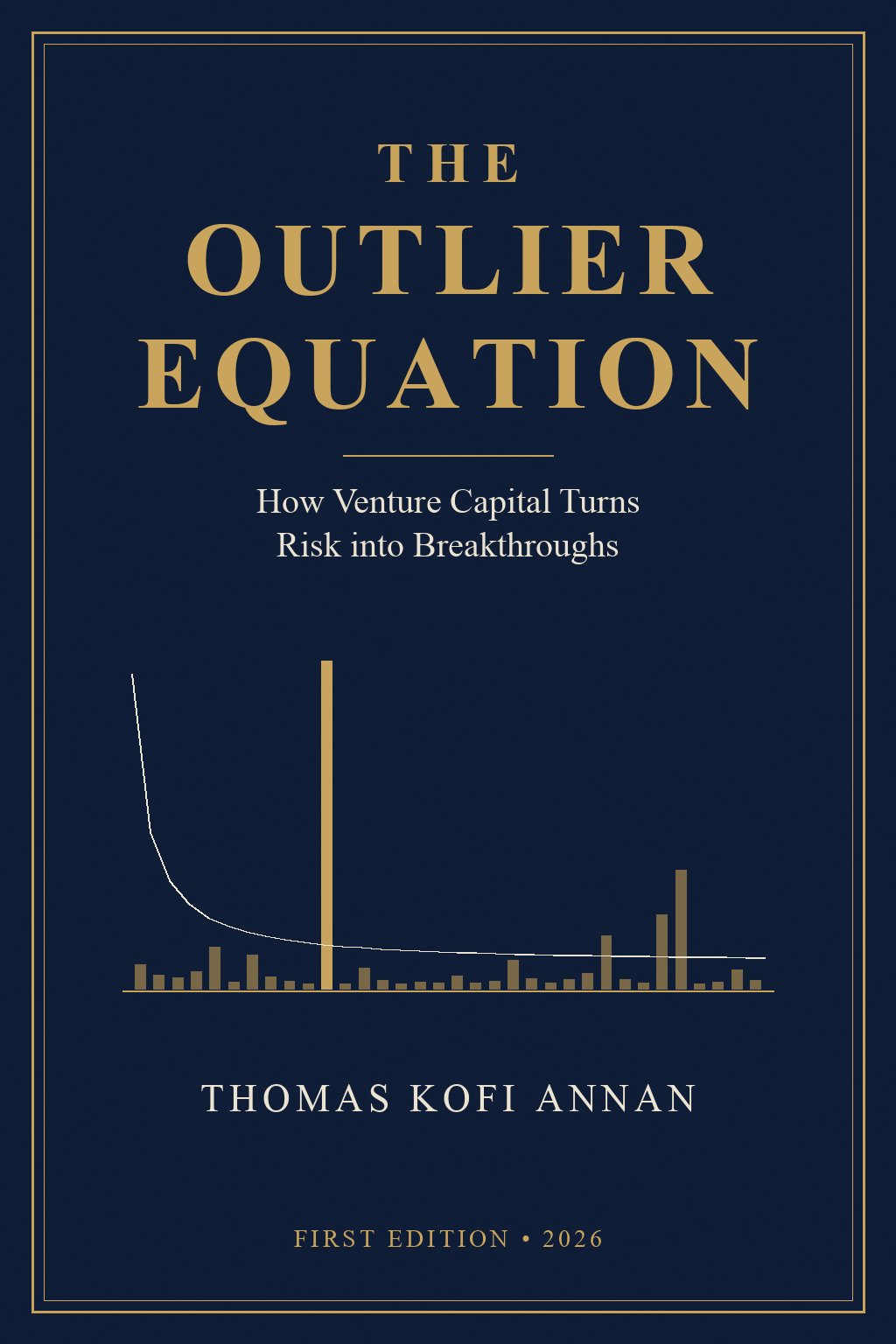
From the research behind The Outlier Equation
How Venture Capital Turns Risk into Breakthroughs
25 chapters, 23 industry studies, 100 firms and 894 strategic moves.
See the bookEducational content, not investment, legal, tax, medical or engineering advice. Figures marked “reported” come from filings and published sources that have not been independently audited.