Venture capital works by pooling money from institutions and wealthy individuals into a fund, buying minority stakes in young private companies before their success is proven, and returning cash when a few of those companies are sold or go public. Most of the investments lose money. The business survives because one or two outliers in each fund return many times the whole fund. The managers earn an annual fee of about 2% and a share of the profits, usually 20%, called carried interest.
The pattern is old and the numbers are extreme. In 1997 Benchmark put a reported $6.7 million into eBay, a stake that became worth billions. In 2005 Accel invested a reported $12.7 million in Facebook's Series A, and that stake was reportedly worth more than $9 billion at the 2012 IPO. In each case one company set the fund's result and the firm's reputation for a decade. This guide explains how the machine behind those numbers works, from the fund contract to the term sheet to the exit, and where it breaks.
What is venture capital?
Venture capital finances companies before the evidence is in. The investor buys a stake in a business that may have no revenue, an unfinished product and a market that has not yet formed. The stake is usually held as convertible preferred stock, which gives the investor the greater of its money back or its share of the company as common stock, plus governance and information rights. At the earliest stages, money often arrives as a SAFE or a convertible note that turns into stock later.
The asymmetry is the whole point. The most an investor can lose on a single deal is the amount invested. The most it can make is fifty, a hundred or a thousand times that. A venture firm is in the business of owning enough of those rare successes to pay for everything else.
Venture is often confused with private equity, but the two are close to opposites.
| Dimension | Buyout (private equity) | Venture capital |
|---|---|---|
| Typical company | Established, cash-generative | Young, usually loss-making |
| Ownership | Control | Minority, often 10–25% at entry |
| Main source of return | Earnings growth, debt paydown, multiple | Growth from near zero to large scale |
| Use of debt | Central | Minor |
| Losses | The exception | The norm |
| Valuation basis | Cash flow and comparable deals | Negotiated price per share, anchored to exit potential |
An investor who applies buyout screens to venture, such as low loss ratios, proven cash flow and control, will reject exactly the companies that produce venture's outliers. For the long version of this comparison, the first chapter of The Outlier Equation sets out the logic of asymmetric returns.
Who provides the money?
A venture firm sells two products. It sells capital and help to founders, and it sells fund interests to investors called limited partners (LPs). Most writing about venture focuses on the first. The second decides whether the firm survives, because a firm that cannot raise its next fund has nothing left to invest.
The LP base is a mix:
| LP type | Role in venture |
|---|---|
| University endowments | Historic anchor of top-tier funds |
| Foundations | Similar to endowments, smaller; sensitive to cash returns |
| Funds-of-funds | Aggregate smaller LPs; often the first institutional check for new managers |
| Family offices and individuals | The core of most first funds and many seed funds |
| Public pensions | A small share of venture; checks often too large for seed funds |
| Sovereign wealth funds | Large commitments to platforms and growth funds |
| Corporations and, since the 2020 Volcker Rule amendment, banks | Strategic and financial LPs |
A first fund is usually raised from people, not institutions: often 40 to 150 individuals and family offices. Legal limits on investor counts shape these vehicles. A standard 3(c)(1) fund can have no more than 100 beneficial owners, and a qualifying venture fund of up to $12 million can have 250.
The fundraising cycle swings hard. US venture fundraising peaked in 2021–22 and then contracted as distributions dried up. The Q4 2025 PitchBook-NVCA Venture Monitor reported $66.1 billion raised across 537 US venture funds in 2025, the lowest dollar total since 2018. Capital concentrated in a few brand names: Andreessen Horowitz's reported $15 billion close in January 2026 was, per PitchBook, more than 18% of US venture commitments since January 2025. The fundraising and LP relations study covers the raise in detail.
How is a venture fund structured?
Most US venture funds are Delaware limited partnerships. LPs commit capital. A general partner (GP) entity makes investment decisions and receives carried interest. A separate management company employs the team and receives the management fee. The limited partnership agreement sets the rules: investment period, term, fees, carry, how proceeds flow back, recycling, key-person clauses and the role of the LP advisory committee.
Money is not handed over on day one. LPs commit, and the fund calls the money as it invests, usually with about ten business days' notice. That is why committed, called and invested capital are three different numbers. The stated life is ten years plus extensions, but real lives often run 12 to 15 years because the best companies take that long to exit.
Large firms add other vehicles on top of the core fund: opportunity funds for later rounds in their own winners, special-purpose vehicles for single deals, and evergreen structures such as the Sequoia Capital Fund created in 2021. Each has its own economics, and an LP should ask which vehicle gets the best deals.
How do venture capitalists get paid?
The classic formula is "2 and 20": a management fee of about 2% a year and 20% of the profits. US practice in 2024–26 looks like this:
| Term | Typical US practice, 2024–2026 |
|---|---|
| Management fee | ~2.0–2.5% of commitments in the investment period |
| Later fee | Steps down, often to ~1.0–1.5% or to invested capital |
| Lifetime fees | ~15–25% of commitments |
| Carried interest | 20% standard; ~25–30% at a few top firms (Benchmark is widely reported at 30%) |
| Preferred return (hurdle) | Often none, unlike the ~8% common in buyouts |
| GP commitment | ~1%, sometimes more |
The fee pays salaries and rent. The carry is where wealth is made, and it arrives only from strong funds, often a decade after the fund closes. Fees and carry open a wide gap between what the portfolio earns and what LPs receive. In the research companion's stylized $100 million fund, a 3.0x gross multiple becomes about 2.45x net with full recycling of fees and about 2.14x without it. That is why managers pitch portfolios targeting 4–5x gross.
Fees also explain a quiet risk. At 2.5%, a $40 million seed fund yields about $1 million a year, enough for two partners at modest salaries. A $1 billion fund at 2% yields about $20 million a year before any carry. Fees scale with assets; the number of great early-stage companies does not. A full breakdown, including the waterfall and recycling, is in our explainer on how VC funds make money.
Why does the power law rule venture capital?
Venture outcomes do not follow a bell curve. They follow a power law, in which a tiny share of investments produces most of the returns. Correlation Ventures' study of roughly 21,000 US financings from 2004 to 2013 reported that about 65% returned less than the capital invested, about 10% returned five times or more, and about 4% returned ten times or more. Horsley Bridge data reported by Andreessen Horowitz for 1985–2014 showed roughly 6% of deals producing about 60% of returns.
Three consequences follow.
- Averages mislead. A few outliers pull the mean far above the median. A distribution calibrated to the Correlation figures has a mean deal multiple of about 2.8x but a median of about 0.5x.
- Hit rate says little about skill. A portfolio in which two-thirds of companies fail can be excellent if one company returns the fund.
- The costliest error is a miss, not a loss. The most you can lose on a seed check is one times the check. Passing on the next Google costs many times the fund.
History confirms the pattern again and again. Kleiner Perkins' first fund, of about $8 million, owed most of its return to Tandem Computers and Genentech. Sequoia invested about $60 million in WhatsApp in total; its stake was reported at about $3 billion when Facebook bought the company. Our explainer on the power law in venture capital works through the math, and the performance and power law study holds the full data.
How do VCs build a portfolio?
The single most useful equation in venture is:
Exit value needed to return the fund = Fund size ÷ Ownership at exit
A $150 million fund owning 10% of a company at exit needs a $1.5 billion sale to return the fund from that one company. A $1 billion fund at the same ownership needs $10 billion. Fund size is therefore strategy. A $400 million "seed" fund planning 25 companies at 15% ownership is really a Series A fund with a seed label.
The research companion simulated thousands of funds with outcomes calibrated to the Correlation data:
| Companies in fund | Median fund multiple | Chance fund returns < 1x | Chance fund returns ≥ 3x |
|---|---|---|---|
| 5 | 1.25x | 41% | 19% |
| 10 | 1.53x | 28% | 19% |
| 30 | 1.87x | 9% | 22% |
| 100 | 2.19x | 0.4% | 24% |
Diversification raises the median and almost removes the chance of losing money, but it barely changes the chance of a great fund. A great fund needs a meaningful position in an outlier. The real trade-off is between breadth, which protects against failure, and ownership, which decides whether success matters.
Ownership also decays. A Series A investor's 20% can fall to about 13% after two more rounds unless it spends reserves. A seed fund's 10% often becomes 4–6% by exit. That is why funds hold back reserves for follow-on investments: about 40–50% of capital for high-volume seed funds and 50–60% for concentrated seed and Series A leads. Underfunding a winner is the most damaging error a fund can make. Chapter 4 on portfolio construction covers reserves in depth.
How do VCs find and choose companies?
Investors themselves rank selection highest. In a survey of 885 institutional venture capitalists by Gompers, Gornall, Kaplan and Strebulaev, 49% named deal selection as the most important driver of value, against 27% for help after investing and 23% for deal flow. The same survey found that the average firm considered about 101 opportunities for each deal it closed, and only about 10% of investments arrived cold.
At the earliest stage there is no data, so investors underwrite people and markets: why this team can win this market, what they believe that others do not, how fast they learn, and whether a Series A firm will want the company in 18 to 24 months. Sequoia's founder Don Valentine made "market first" a doctrine: a large, fast-growing market can carry a mediocre team, and a great team cannot rescue a bad market.
Stages are best defined by what each round proves:
| Stage | What the money proves | Typical US round, 2024–26 |
|---|---|---|
| Angel | The founders can recruit capital and talent | $50,000–$500,000 |
| Pre-seed | The product can be built and someone wants it | ~$0.5–3 million |
| Seed | Early product-market fit and a first channel | ~$2–6 million |
| Series A | A first repeatable way to acquire customers | Lead buys ~15–25% |
| Series B | Go-to-market can scale efficiently | Lead buys ~10–20% |
Carta reported a median Series A pre-money valuation of about $48 million in Q1 2025. If you are on the founder side, our guide on how to raise a seed round applies these mechanics.
How are startups valued?
Venture valuation is not discounted cash flow. It is a negotiated price per share for a security with preferences, usually set by working backward from a hoped-for exit and the ownership the investor needs.
The basic arithmetic: post-money valuation equals the investment divided by the new investor's percentage, and pre-money equals post-money minus the new money. A "$60 million valuation" usually means an investor paid $12 million for 20%, not that anyone would buy the whole company for $60 million. Price per share equals the pre-money valuation divided by the fully diluted share count, and the real negotiation is over what counts in that denominator. Investors usually require a new option pool of 10–15% to be created inside the pre-money. In the companion's example, a $48 million headline pre-money with a 10% pool has an effective pre-money of about $43.2 million.
The venture capital method, codified in William Sahlman's 1987 Harvard Business School note, prices from the exit back: maximum post-money equals exit value times the share of ownership that survives later dilution, divided by the target multiple. In the book's worked example, an investor who sees an $800 million success case, expects to keep 60% of its stake through later rounds and wants 10x would pay at most $48 million post-money. Weighted for realistic odds of failure, the deal's expected multiple is only about 2.2x, and the 5% outlier scenario supplies about 56% of the expected value. That is why investors price so that the success case returns the fund.
What is in a VC term sheet?
The same headline valuation can produce very different results for founders, because terms decide how proceeds are split and who controls what. The economic terms that matter most:
- Liquidation preference. On a sale, preferred holders get their money back before common holders get anything. A 1x non-participating preference is standard: Cooley reported that 95.8% of its Q2 2026 deals had a 1x preference and 96.4% were non-participating.
- Anti-dilution. In a down round, the investor's conversion price falls. The broad-based weighted average formula is the default; a full ratchet is rare and punitive.
- Pay-to-play. Investors who do not join a new round lose rights. Cooley reported it in 8.4% of Q2 2026 deals.
Control terms include board seats, protective provisions (vetoes over a sale, new senior securities and board size), drag-along rights and pro rata rights. Terms matter mostly in the middle of the distribution. In a fund-returning exit every series converts to common and the terms disappear; in a total loss nothing helps. Terms decide the modest sales where most companies end up. Our guide on how to read a VC term sheet goes clause by clause, and SAFEs versus convertible notes covers the instruments used before the first priced round.
What happens after the investment?
After the money is wired, the investor's job becomes governing, helping and deciding whether to invest more. A venture investor usually holds a minority stake on a board the founders often control. A typical Series A board has two common seats and one investor seat. Its influence comes from contract rights, the follow-on checkbook and being useful.
Each follow-on investment is a new decision. The test is simple: if the firm had never met this company, would it invest at this price, on these terms? Most firms review their portfolios quarterly, sorting companies into breakouts that deserve maximum ownership, solid companies preparing for the next round, strugglers that need a decision with a date, and wind-downs that deserve an orderly end. Repeated insider bridges delay the decision and lock up reserves that the winners need.
Governance failures cluster where boards are weak. Theranos, WeWork and FTX all combined a dominant founder with weak or absent independent oversight. At FTX, investors accepted no board seats at all.
How do venture investors make money in the end?
A fund's paper value is an estimate. Its distributions are cash. Exits come in several forms:
| Route | Typical role |
|---|---|
| Strategic acquisition | Roughly 80–90% of venture-backed exits by count |
| Financial-sponsor buyout | Rising share since about 2015 |
| IPO | Small share by count, most value in strong years |
| Direct listing | Rare; pioneered by Spotify in 2018 |
| Secondary sale or tender | Growing; partial liquidity while private |
The headline price is not what investors receive. Escrows of about 10% for 12 to 18 months, earn-outs, acquirer stock, retention pools, fees and debt repayment can cut realized value by 10–30% or more. Companies also stay private far longer: the median age of US technology companies at IPO rose from about four or five years in the 1990s to ten or more, by Jay Ritter's data.
This is why limited partners watch DPI (distributions to paid-in capital) above everything else. Carta reported a median DPI of about 0.27x across roughly 2,500 US venture funds in early 2025, with only about a third of 2019 and 2020 vintages having made any distribution. Practitioners sum up the lesson as "DPI is truth, TVPI is a hypothesis." Chapter 11 on exits and the exits study cover each route.
Does venture capital beat the stock market?
It depends heavily on vintage and manager. Research by Harris, Jenkinson and Kaplan found that US venture funds of the 1990s beat public markets by wide margins, that 2000s vintages on average lagged, and that 2010s vintages were mixed and partly unrealized. The Kauffman Foundation's 2012 review of its own venture program reported that only about 20 of roughly 100 funds beat public markets by more than 3% a year, while about 62 failed to beat public markets after fees.
The spread between managers is wide, and returns persist more than in most asset classes. Kaplan and Schoar found that venture returns persist across a manager's successive funds. The catch is access: the best funds are often closed to new investors. That is why "access" is the word heard most often in venture fundraising.
How the cycle shapes everything
History shows a few mechanisms that keep recurring. Capital supply predicts lower returns: the mid-1980s, 1999–2000 and 2021 vintages underperformed after fundraising spikes. New entrants arrive at the top: mutual funds in 1999, SoftBank in 2017–19, and crossover funds in 2021 entered late, and prices reversed when they left.
The 2021 round trip is the freshest example. US venture investment hit a record of roughly $350 billion in 2021, by PitchBook-NVCA figures that have been revised several times. Tiger Global reportedly made more than 300 private investments in a year with minimal diligence. Then the Federal Reserve raised rates to 5.25–5.50% by July 2023, public software multiples fell by more than half, and late-stage prices reset. Klarna went from a reported $45.6 billion valuation in 2021 to a $6.7 billion down round in 2022. The stories of SoftBank's Vision Fund and Tiger Global show the same lesson from two directions, and our list of the biggest venture capital failures shows how often the losses cluster at market peaks.
The AI cycle began with ChatGPT in November 2022. AI accounted for roughly 65% of US venture deal value in 2025, according to the PitchBook-NVCA Venture Monitor, much of it in a few foundation-model rounds such as OpenAI's reported $40 billion at a $300 billion post-money valuation in March 2025.
The four factors that decide a venture return
The Outlier Equation frames venture around how asymmetry is created, priced, governed and turned into cash. Read as an equation, those four factors multiply:
| Factor | The question | Where it went to zero |
|---|---|---|
| Creation | Can this company become an outlier? | Quibi raised about $1.75 billion and shut within about six months of launch |
| Price | Will we own enough, at a price that leaves room to win? | Hinge Health listed in 2025 at roughly half its 2021 round valuation |
| Governance | Do the terms and the board protect value in the middle? | FTX had no independent board; investors were wiped out |
| Realization | Can value become cash? | Many 2021 IPO positions lost 50–80% between pricing and lockup expiry |
Because the factors multiply, strength in one cannot rescue a zero in another. A real outlier bought at a price that leaves no upside returns little. A great price on a company that cannot scale returns nothing. Paper gains that never become distributions do not pay LPs. The best venture records, from Sequoia's Google position to Sutter Hill's Snowflake stake, held all four at once.
The takeaway
Venture capital is a fund business built on a power law: LPs commit capital for a decade or more, managers charge about 2% and take about 20% of profits, and one or two companies per fund pay for all the losses. The disciplines that matter follow from that shape: fund size consistent with ownership, reserves concentrated in winners, terms that work in the middle cases, and a plan for turning paper value into cash. Most failures in the industry trace to forgetting one of these when money is plentiful. To follow the whole system from fund contract to exit, start with The Outlier Equation, beginning with Chapter 3 on fund economics.
Frequently asked questions
Where does venture capital money come from?+
Mostly from limited partners: university endowments, foundations, pensions, sovereign funds, family offices, funds-of-funds and wealthy individuals. A first-time fund is usually raised from 40 to 150 individuals and family offices rather than institutions.
What percentage of venture-backed startups fail?+
Correlation Ventures' study of roughly 21,000 US financings from 2004 to 2013 found that about 65% returned less than the money invested. Only about 4% returned ten times or more.
How long does a venture capital fund last?+
The stated life is usually ten years plus one or two one-year extensions, but real fund lives often stretch to 12 to 15 years because the best companies take that long to exit.
Is venture capital the same as private equity?+
No. Buyout firms take control of established, cash-generating companies and use debt; venture investors take minority stakes, usually 10% to 25% at entry, in young loss-making companies and expect most of them to fail.
How much of a company does a VC usually take?+
A Series A lead typically buys about 15% to 25%, with 20% as the common anchor. Seed investors usually take less per firm, and founders typically sell 15% to 25% of the company in a seed round in total.
Go deeper in The Outlier Equation
Chapters
Industry studies
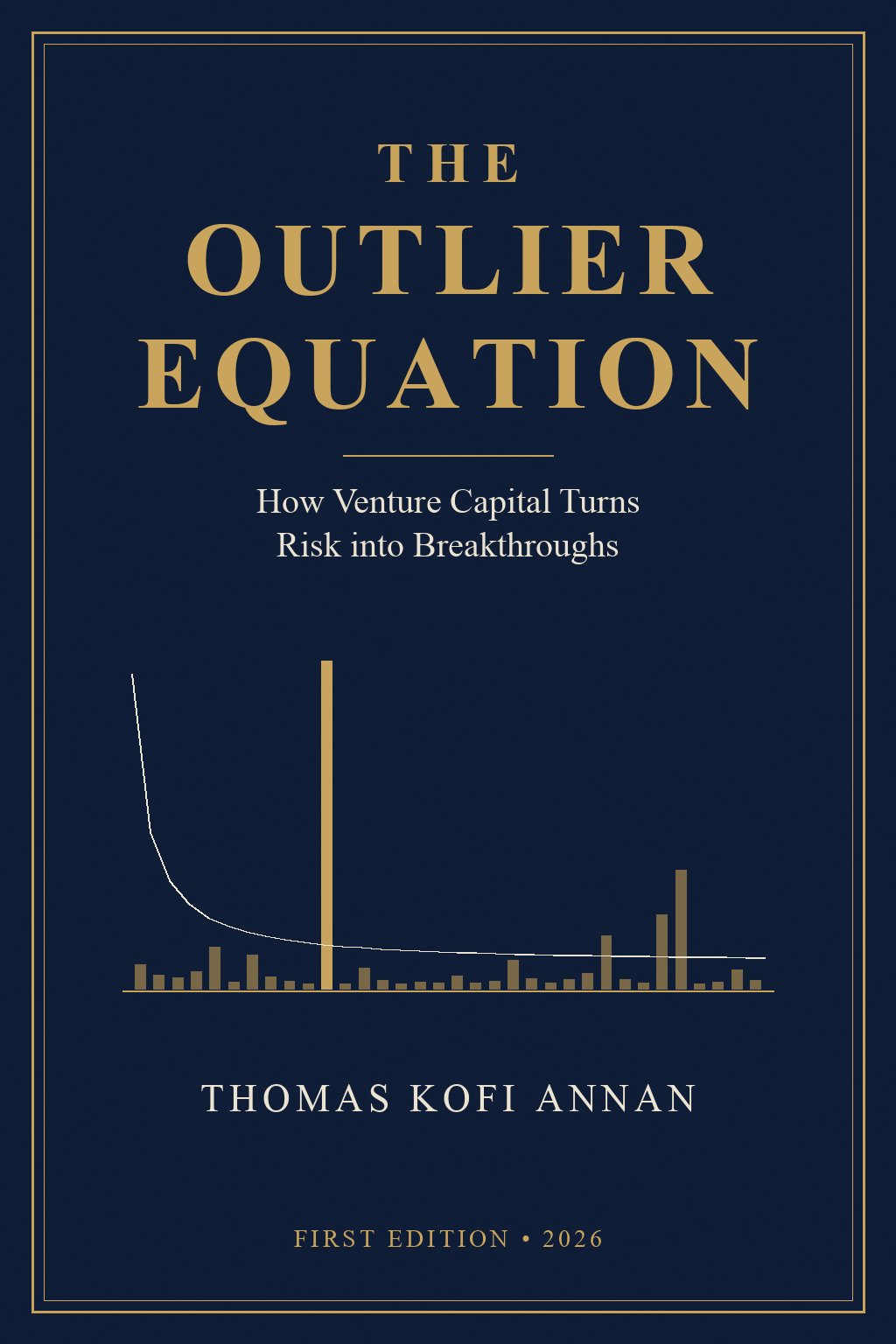
From the research behind The Outlier Equation
How Venture Capital Turns Risk into Breakthroughs
25 chapters, 23 industry studies, 100 firms and 894 strategic moves.
See the bookEducational content, not investment, legal, tax, medical or engineering advice. Figures marked “reported” come from filings and published sources that have not been independently audited.